MICROSOFT CORPORATION
QITABI 2 Project Indicators & KPIs Monitoring Dashboard
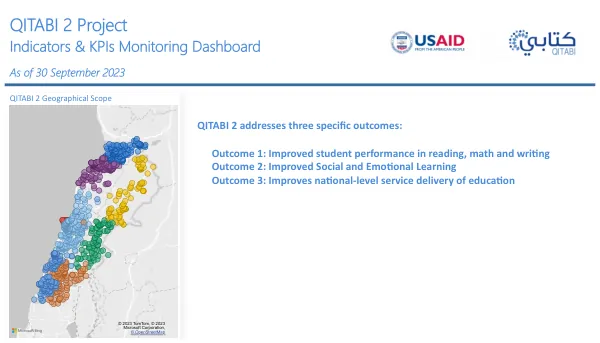
QITABI 2 Project addresses five specific outcomes: Improved student performance in reading, math, and writing; Improved Social and Emotional Learning; Improved national-level service delivery of education; Increased access to education; and Enhanced education quality.
2023 · 11 pages
Sign in to readA free account is required to download.
Abstract
The project focuses on five key areas: primary education, secondary education, teacher training, education management, and education infrastructure. Outcome 1: Improved student performance in reading, math, and writing is measured through several indicators. Indicators include the number of primary school educators who complete professional development activities on evidence-based reading instruction, the number of learners reached in reading programs at the primary level, and the number of primary school educators who complete professional development activities on evidence-based math instruction. In FY2020, the number of primary school educators who completed professional development activities on evidence-based reading instruction was 0, while the number of learners reached in reading programs at the primary level was 887. In FY2021, the number of primary school educators who completed professional development activities on evidence-based math instruction was 1,601, while the number of learners reached in reading programs at the primary level was 907. Outcome 2: Improved Social and Emotional Learning is measured through several indicators. Indicators include the number of youth who are trained in soft skills and life skills through USG-assisted programs, the number of schools with leadership trained to implement Social and Emotional Learning, and the number of teachers who have received training in Social and Emotional Learning. In FY2020, the number of youth who were trained in soft skills and life skills through USG-assisted programs was 0, while the number of schools with leadership trained to implement Social and Emotional Learning was 522. In FY2021, the number of teachers who had received training in Social and Emotional Learning was 11,302. Outcome 3: Improved national-level service delivery of education is measured through several indicators. Indicators include the number of education administrators and education administrators who complete professional development activities with USG assistance, the number of management and monitoring systems, procedures, and tools recommended and/or introduced to the Ministry of Education and Higher Education and the Central Administration of Education and Research, and the number of public and private schools receiving USG assistance. In FY2020, the number of education administrators who completed professional development activities with USG assistance was 170, while the number of public and private schools receiving USG assistance was 0. In FY2021, the number of education administrators who completed professional development activities with USG assistance was 11, while the number of public and private schools receiving USG assistance was 987. The project also tracks several key performance indicators, including the number of public and private schools receiving USG assistance, the number of primary or secondary educators who complete professional development activities with USG assistance, and the number of learners in primary schools or non-school based settings reached with USG education assistance. In FY2020, the number of public and private schools receiving USG assistance was 0, while the number of learners in primary schools or non-school based settings reached with USG education assistance was 0. In FY2021, the number of public and private schools receiving USG assistance was 987, while the number of learners in primary schools or non-school based settings reached with USG education assistance was 159,315. The project also tracks the number of primary or secondary textbooks and other teaching and learning materials provided with USG assistance. In FY2020, the number of primary or secondary textbooks and other teaching and learning materials provided with USG assistance was 0. In FY2021, the number of primary or secondary textbooks and other teaching and learning materials provided with USG assistance was 274,575.