USAID
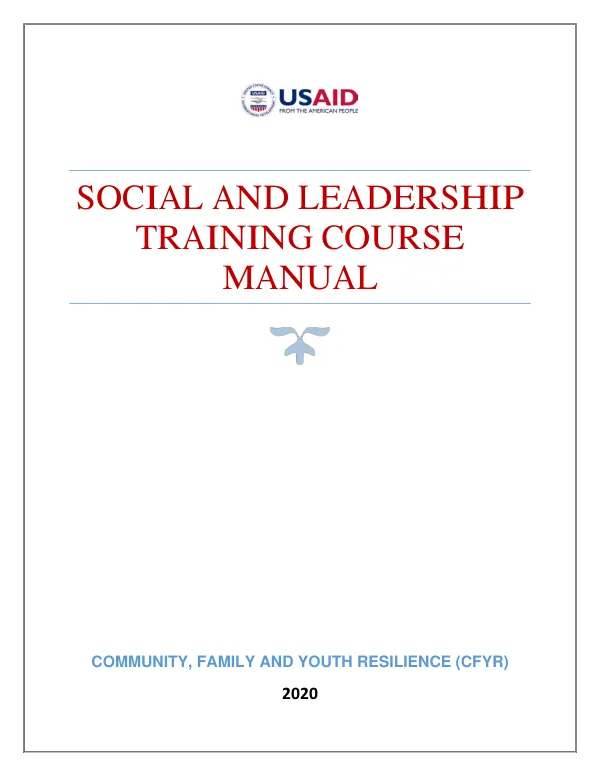
Social and Leadership Training Course Manual
The Community, Family, and Youth Resilience (CFYR) training course manual is a comprehensive guide for individuals seeking to develop their self-awareness, leadership, and life skills.
2020 · 154 pages
Sign in to readA free account is required to download.
Abstract
The manual is divided into 12 sessions, each focusing on a specific aspect of personal development. Session 1, Self-Awareness, is the foundation of the training course. The session aims to enable participants to attain a level of self-awareness that empowers them to handle difficult situations. The session consists of four activities: defining self-awareness, the Johari Window model, developing and increasing self-awareness, and self-efficacy. Self-awareness is defined as having a clear perception of one's personality, including strengths, weaknesses, thoughts, beliefs, motivation, and emotions. The Johari Window model is a tool used to understand self-awareness, consisting of four quadrants: open, hidden, blind, and unknown. Participants are encouraged to test themselves on the Johari Window model to gain a deeper understanding of their self-awareness. Developing and increasing self-awareness involves conducting a self-assessment, setting goals, keeping a journal, and engaging in daily self-reflection. Participants are also encouraged to ask trusted family members and friends for feedback and engage in new activities or take on new challenges. Self-efficacy is a person's belief in their ability to succeed in a particular situation. People with a strong sense of self-efficacy view challenging tasks as something to be mastered, develop a deeper interest in activities, and form a stronger sense of commitment. On the other hand, people with a weak or low sense of self-efficacy avoid challenging tasks, believe that difficult tasks are beyond their capabilities, and focus on personal feelings and negative outcomes. The development of self-efficacy is a complex process, and participants are encouraged to reflect on their own experiences and identify the elements that contribute to their self-efficacy. The manual provides a diagram and matrix to help participants assess their self-efficacy and identify areas for improvement. Throughout the training course, participants are encouraged to engage in activities, exercises, and discussions to develop their self-awareness, leadership, and life skills. The manual provides a comprehensive guide for facilitators to lead the training sessions and ensure that participants achieve the learning goals. The training course manual is designed to be flexible and adaptable to different contexts and cultures. The manual provides a range of materials, including flip chart paper, markers, blank paper, self-analysis assessment questions, and a diagram of the Johari Window model. The training course manual is a valuable resource for individuals seeking to develop their self-awareness, leadership, and life skills. The manual provides a comprehensive guide for participants to develop their skills and knowledge, and facilitators to lead the training sessions effectively.