DELOITTE CONSULTING, LLP
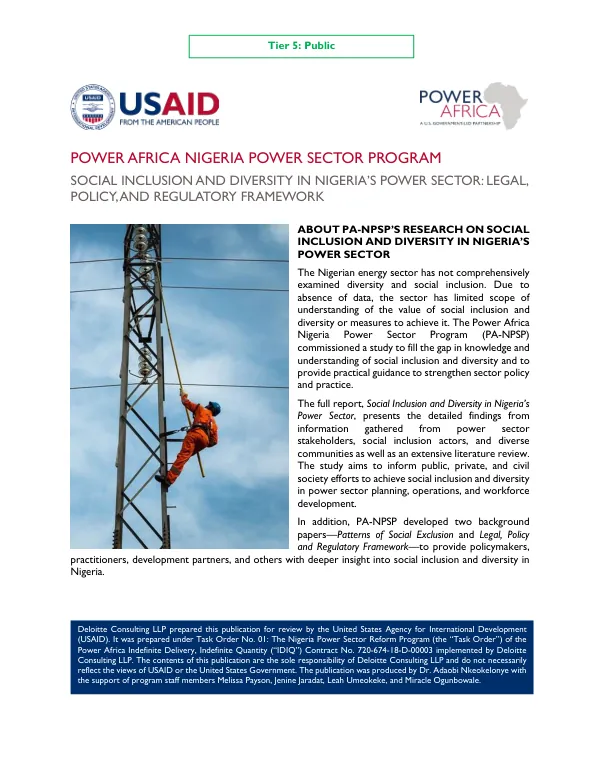
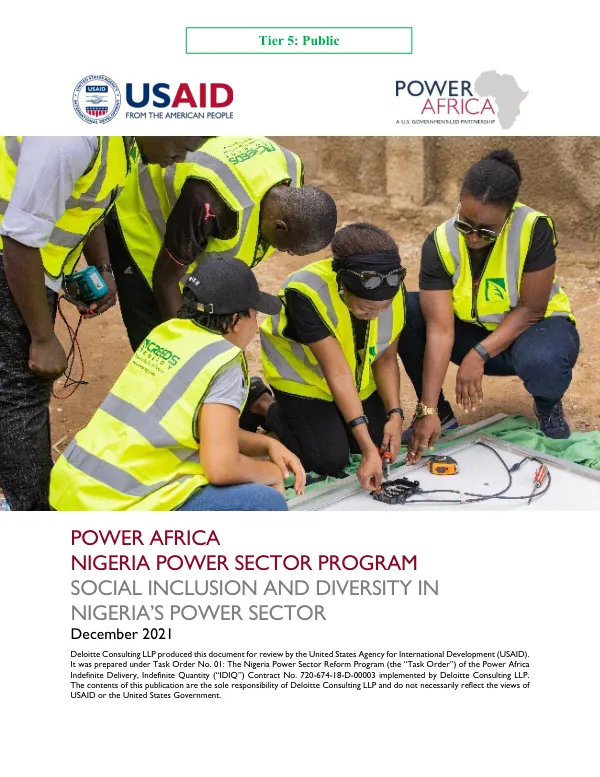
Social Inclusion and Diversity in Nigeria’s Power Sector
The Power Africa Nigeria Power Sector Program (PA-NPSP) is a USAID-funded initiative implemented by Deloitte Consulting LLP under Power Africa.
2021 · 77 pages
Sign in to readA free account is required to download.
Abstract
The program aims to promote social inclusion and diversity in Nigeria's power sector. The research was led by Dr. Adaobi Nkeokelonye and supported by a team of experts, including Dr. Binta Iliyasu, Dr. Folake Akinbode, and others. The program's research focused on understanding the social inclusion and diversity challenges in Nigeria's power sector. The study involved interviews, focus group discussions, and workshops with various stakeholders, including government ministries, departments, and agencies, development partners, private sector companies, and civil society organizations. The research aimed to identify entry points for promoting social inclusion and diversity in the power sector. The study found that Nigeria's power sector is characterized by a lack of social inclusion and diversity. The workforce profile and practices in the sector are dominated by men, with limited representation of women and other marginalized groups. The study also identified a lack of awareness and understanding of international obligations and national laws, policies, and plans related to social inclusion and diversity in the power sector. The research highlighted the importance of promoting social inclusion and diversity in the power sector to ensure that the benefits of electricity access are shared equitably among all segments of the population. The study recommended that the government, development partners, and private sector companies work together to promote social inclusion and diversity in the power sector. The PA-NPSP program has made significant contributions to the research concept, design, and report. The program's technical staff, under the leadership of Arthur Sedestrom and M.K. Balaji, provided insightful comments on the value chain. The program's Chief of Party, Mary Worzala, and Deputy Chief of Party, Tunde Gbajumo, also provided valuable input. The study's findings and recommendations have important implications for the power sector in Nigeria. The research highlights the need for a more inclusive and diverse workforce, as well as the importance of promoting social inclusion and diversity in the power sector to ensure that the benefits of electricity access are shared equitably among all segments of the population. The study's methodology involved a combination of qualitative and quantitative research methods, including interviews, focus group discussions, and workshops with various stakeholders. The research aimed to identify entry points for promoting social inclusion and diversity in the power sector and to provide recommendations for improving the social inclusion and diversity of the workforce in the sector. The study's recommendations include promoting social inclusion and diversity in the power sector through the development of policies and programs that support the inclusion of marginalized groups, such as women and youth, in the workforce. The study also recommends that the government, development partners, and private sector companies work together to promote social inclusion and diversity in the power sector and to ensure that the benefits of electricity access are shared equitably among all segments of the population. The study's findings and recommendations have important implications for the power sector in Nigeria and highlight the need for a more inclusive and diverse workforce. The research provides a valuable contribution to the understanding of social inclusion and diversity in the power sector and highlights the importance of promoting social inclusion and diversity in the sector to ensure that the benefits of electricity access are shared equitably among all segments of the population.