USAID DEC
Sokoto, Nigeria: Strong Supply Chains Ensure Available LLINs for 1,000,000 Households, November 2014
Sign inJOHN SNOW INTERNATIONAL
Sokoto, Nigeria: Strong Supply Chains Ensure Available LLINs for 1,000,000 Households, November 2014
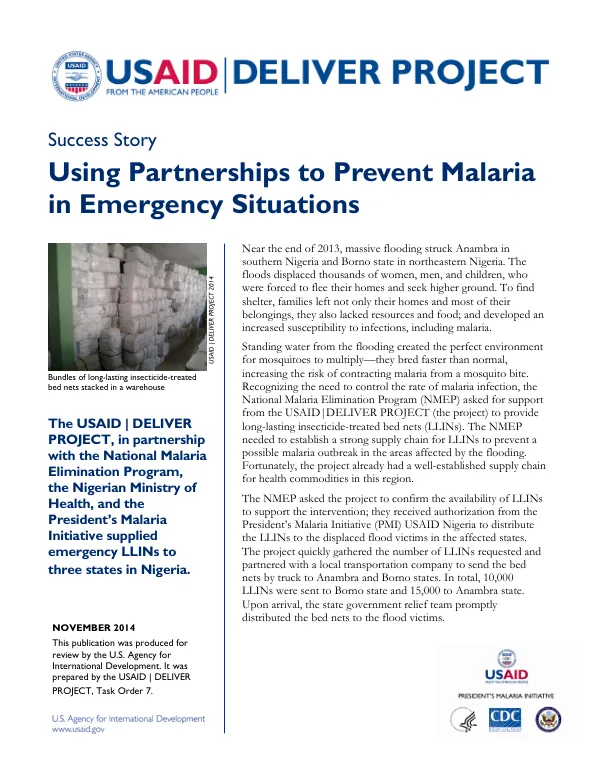
The USAID | DELIVER PROJECT, in collaboration with the National Malaria Elimination Program (NMEP), the Global Fund to Fight AIDS, Tuberculosis and Malaria (GFATM), and the President's Malaria Initiative (PMI), has been working to reduce the number of malaria cases in Sokoto state, Nigeria.
2014 · 2 pages
Sign in to readA free account is required to download.
Abstract
Malaria is a significant public health concern in Nigeria, with an estimated 225,000 deaths per year, and 11 percent of maternal deaths attributed to the disease. In Sokoto state, the risk of contracting malaria is at its peak for three to six months of the year, and the disease also has a devastating economic impact, as it leaves little time for farming and livestock care. To combat this issue, the project has been providing long-lasting insecticide-treated bed nets (LLINs) to households in Sokoto state since 2009. Mass distribution campaigns are regularly held to ensure that every household has and uses an LLIN. LLINs have an estimated life span of three years, and replacement campaigns encourage communities to replace their bed nets and alert the population about available malaria treatment and prevention. The project has also provided additional information to community members to help them understand the importance of replacing their bed nets, even if they appear to be in good condition. In late 2013, the NMEP was ready to hold a mass replacement campaign in Sokoto state, and the USAID | DELIVER PROJECT provided technical assistance to the NMEP and the Sokoto state government. The project, in coordination with GFATM, procured, transported, and warehoused 2.5 million replacement LLINs, which were then distributed by the Targeted States High Impact Project (TSHIP) and Roll Back Malaria (RBM) partnership during a five-day campaign in December 2013. The supply chain worked seamlessly to deliver the LLINs to the 23 local government areas (LGAs) in Sokoto state, followed by an additional delivery to 854 ward-level distribution points. By the end of the campaign, the team distributed 2.5 million LLINs to households in Sokoto, providing at least one LLIN to 93 percent of the targeted households. The NMEP will follow up with a one-year, post-campaign behavior change communication, after which a net-use and retention-rate survey will help determine if households are still using their bed nets consistently and correctly. Through the coordinated effort of the Sokoto state government, the NMEP, TSHIP, and the project, the LLIN replacement campaign in Sokoto ensured the continued availability of LLINs to protect against malaria-carrying mosquitoes for more than one million households. The USAID | DELIVER PROJECT is funded by USAID and implemented by John Snow, Inc. The project supports USAID's implementation of malaria prevention and treatment programs by procuring, managing, and delivering high-quality, safe, and effective malaria commodities, providing on-the-ground logistics capacity, technical assistance, and pharmaceutical management expertise, and offering technical leadership to strengthen the global supply, demand, and financing of malaria commodities.
Related documents