USAID | PROJECTO DELIVER
Nigeria: Bauchi & Ebonyi DDIC Pilot
The Direct Delivery and Information Capture (DDIC) model is a vendor-managed inventory (VMI) system that enables delivery teams to use an automated inventory control process to replenish health facilities with commodities.
2015 · 1 pages
Sign in to readA free account is required to download.
Abstract
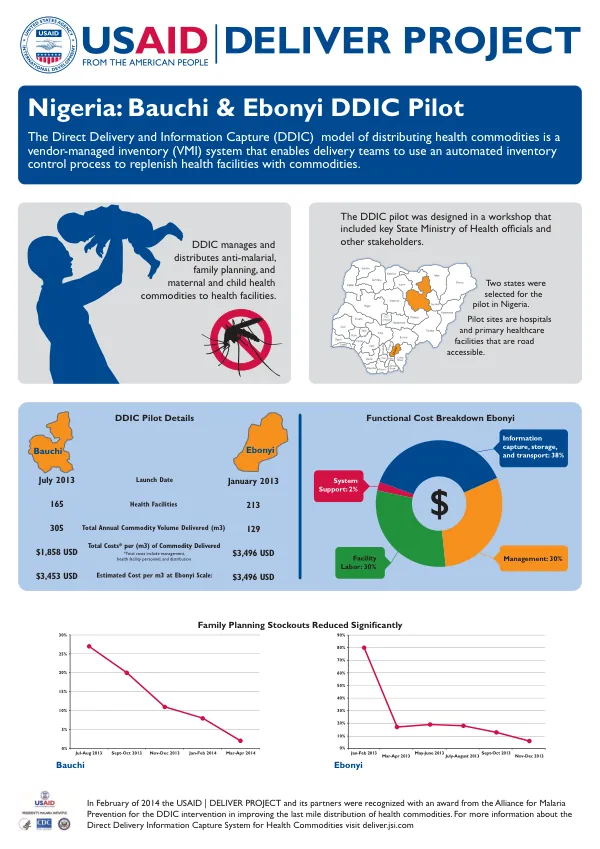
This system is designed to manage and distribute anti-malarial, family planning, and maternal and child health commodities to health facilities. The DDIC pilot was implemented in two states in Nigeria, Bauchi and Ebonyi, with the goal of improving the distribution of health commodities to health facilities. The pilot sites consisted of hospitals and primary healthcare facilities that were road accessible. The DDIC pilot was launched in July 2013, with a total of 165 health facilities participating in the program. The DDIC model resulted in significant reductions in stockouts of family planning commodities. In Bauchi, the number of stockouts decreased steadily from June to August 2013, and then continued to decline through March and April 2014. In Ebonyi, the number of stockouts showed a sharp decline from January to February 2013, followed by a steady decline through November and October 2013. The estimated cost per cubic meter of commodity delivered was $1,858 USD in Bauchi and $3,496 USD in Ebonyi. The functional cost breakdown for the DDIC pilot in Ebonyi showed that information capture, storage, and transport accounted for 38% of the total costs, while system support accounted for 2% and facility labor accounted for 30%. Management costs also accounted for 30% of the total costs. The USAID | DELIVER PROJECT and its partners were recognized with an award from the Alliance for Malaria Prevention in February 2014 for their work on the DDIC intervention. The award acknowledged the project's success in improving the last mile distribution of health commodities. The DDIC model has been recognized as a best practice in the distribution of health commodities, and its implementation has been replicated in other countries.