OPEN UNIVERSITY
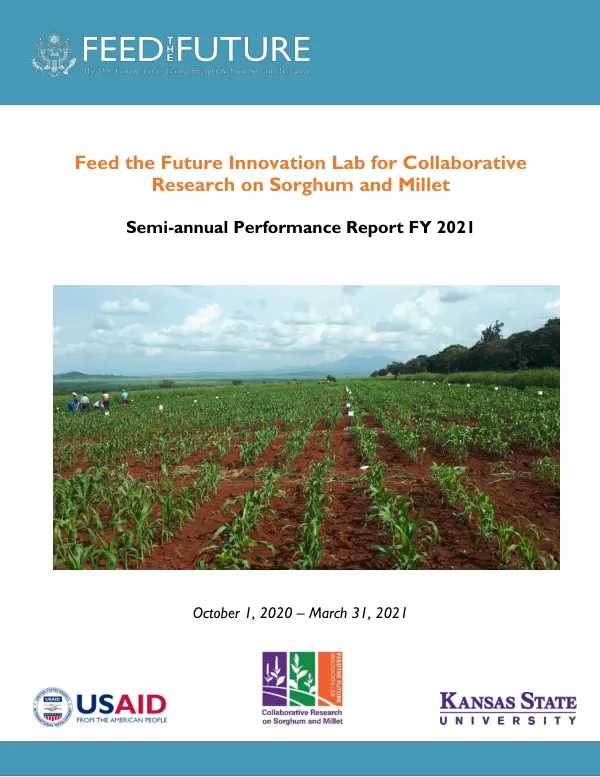
Sorghum and Millet Innovation Lab Semi-Annual Performance Report – FY 2021
The Sorghum and Millet Innovation Lab is a research program focused on improving the productivity and resilience of sorghum and millet crops in Africa.
2021 · 12 pages
Sign in to readA free account is required to download.
Abstract
The program is funded by the United States Agency for International Development (USAID) and is implemented by Kansas State University. The program's research activities are primarily conducted in West Africa, including countries such as Niger, Senegal, and Ethiopia. During the first two quarters of FY 2021, the program maintained activities initiated during the COVID-19 pandemic. Field trials were completed in West Africa and Senegal, while food product development trainings slowed due to local regulations. Data analysis and interpretation were initiated in preparation for presentation at the annual SMIL meeting. The program held its annual meeting in a virtual format, with participation by nearly 100 scientists, development practitioners, and private sector partners. The meeting saw presentations on activities completed in 2020, planned activities for 2021, and adjustments for the COVID-19 pandemic. The program invested considerable effort in strategic planning for technology dissemination and scaling in Ethiopia and West Africa. Technology dissemination plans cover all areas of inquiry and are tailored to the specific product and environment. The program also conducted short-term trainings in Niger, focusing on hands-on methods of tissue collection and genotyping, end-of-season monitoring meetings on seedball technology, and training on awareness of risks and implications associated with the COVID-19 pandemic. Long-term training was also a key component of the program, with five long-term trainees graduating with Master's degrees and five with a Ph.D. during the reporting period. A total of 85 long-term trainees have been supported by the program since its inception, with 19 currently active and 18 who started in phase 2. The trainees represent a variety of degree levels, including Bachelor's, Master's, and Ph.D. degrees, and come from a range of countries, including Mali, Niger, Senegal, Burkina Faso, Ethiopia, and Haiti. The program's research progress during the reporting period was focused on genetic improvement and production systems management. Field activities were completed, including on-station, farmer participatory, and nursery trials. Data was assembled, reviewed, and preliminary analysis was conducted. Winter nurseries were also planned and planted, and food product development was largely confined to laboratory tests and analyses due to local restrictions. The program's human and institutional capacity development activities were also significant, with short-term trainings conducted in Niger and long-term training programs ongoing. The program's research progress and capacity development activities are critical to improving the productivity and resilience of sorghum and millet crops in Africa.