CORNELL UNIVARSITY INTERNATIONAL
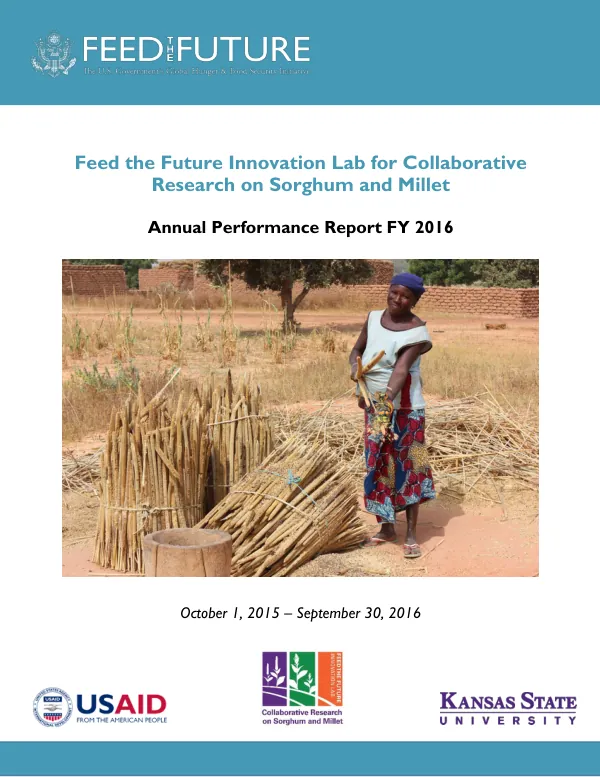
Sorghum and Millet Innovation Lab Annual Performance Report – FY 2016
The Feed the Future Innovation Lab for Collaborative Research on Sorghum and Millet completed its third year of programmatic activities in late July 2016.
2016 · 73 pages
Sign in to readA free account is required to download.
Abstract
At that point in time, the third year of field-based research activities was firmly in the ground in Ethiopia, Senegal, Niger, Mali, Burkina Faso, the United States, and South Africa after capitalizing upon off-season nurseries in many of the same locations. Harvest will begin in the 2017 fiscal year. Being at the mid-point of the program, research activities can be characterized as being in a "young adult" stage with many activities building upon foundations of initial trials in a search for additional data to build evidentiary bases for field phenotyping, genetic, agronomic, and integrated pest management innovations. New, targeted research projects have been initiated that will contribute to genetic enhancement of sorghum and pearl millet. A new project designed to harness the potential of genomics-assisted sorghum breeding was approved after several months of project development, and will focus on application to a small country context with new collaborations between Haiti, Kansas State University, and Cornell University. The pearl millet improvement program is also advancing after the hiring of a pearl millet breeder by Kansas State University in late FY 2015. This program revived the Kansas breeding program and initiated greenhouse studies during the winter, leading to seasonal field trials, intellectual and materials exchange with the West African breeding team, and a field monitoring tour of West African materials in September. Building these research projects has required investment in long-term capacity building through students and post-doctoral researchers. The Lab surpassed its original planning goals for long-term training with the cohort of students starting in the 2016-2017 academic year, and this leads to anticipate even higher numbers by the end of the program. Currently, thirty-eight students are enrolled in degree-seeking post-graduate coursework. In addition to the students that were originally identified in project proposals, intermediate research findings have generated new questions and opportunities. Through judicious use of available and leveraged funding, additional students were mobilized to contribute to the program's goals. The Management Entity (ME) continues to contribute to human and institutional capacity development in our target countries through environmental management and mitigation support and training, facilitating private-public sector linkages in Ethiopia with the Kansas Department of Agriculture, and building cross-cutting research activities on gender, mechanization, and livestock. Leveraged university resources are being invested in applied economics research in West Africa and Ethiopia with supervision supplied by the director. The ME is working outside of target countries to build a stronger research and development community by participating in local agricultural field days and STEM outreach activities to emphasize the domestic and international linkages in sorghum and pearl millet science. The director has assumed leadership of the Innovation Lab Council, which is the umbrella group facilitating interaction between USAID and the Innovation Lab directors and staff. The program has made significant progress in building research capacity in the target countries, with a focus on genetic enhancement of sorghum and pearl millet. The new project on genomics-assisted sorghum breeding is expected to contribute significantly to the program's goals, and the pearl millet improvement program is advancing rapidly. The Lab has also made significant investments in long-term capacity building, with a cohort of students starting in the 2016-2017 academic year. The Management Entity continues to play a key role in building human and institutional capacity in the target countries, and is working to build a stronger research and development community through participation in local agricultural field days and STEM outreach activities.