USAID DEC
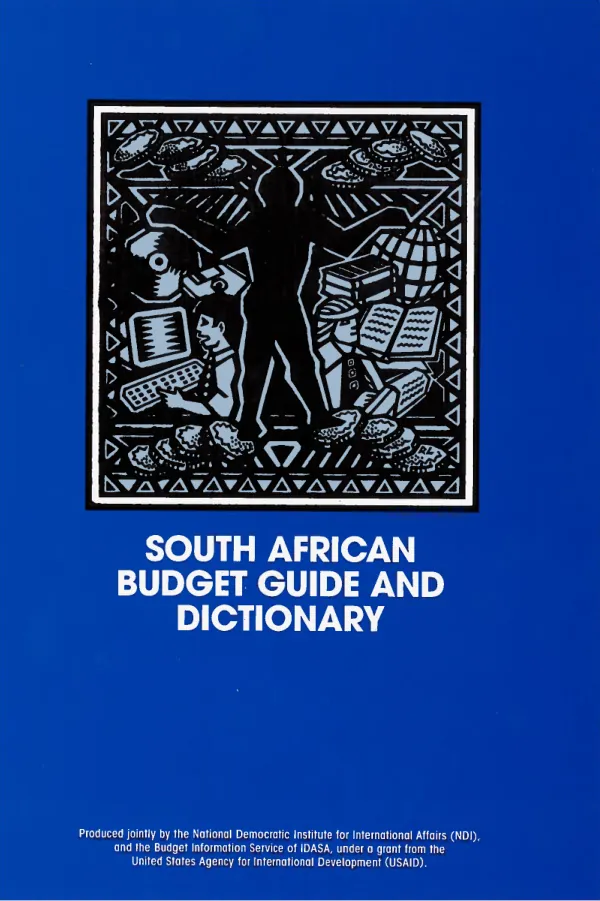
South African Budget Guide
The South African Budget Guide is a comprehensive resource produced by the National Democratic Institute for International Affairs under a grant from the United States Agency for International Development.
2012 · 134 pages
Sign in to readA free account is required to download.
Abstract
The guide provides an overview of the government budgeting process in South Africa, focusing on the division of revenue between national, provincial, and local government spheres. The budget is organized into three main divisions: vertical, horizontal, and local government. The vertical division refers to the distribution of revenue between national, provincial, and local government, with the national government responsible for 70% of total revenue. The remaining 30% is divided between provincial and local government, with the latter receiving 15% and the former 15%. Provincial government is further divided into nine provinces, each with its own share of revenue. The horizontal division of revenue refers to the allocation of funds within each province, with the Equitable Share being the primary source of revenue for each province. The Equitable Share is calculated based on the province's population, with each province receiving a minimum of 5% of the total revenue. Conditional Grants are also allocated to provinces based on specific criteria, such as poverty reduction and economic development. Local government receives its share of revenue through the Division of Revenue Act, which allocates funds to municipalities based on their population and economic needs. The Medium Term Expenditure Framework (MTEF) is a key component of the budget process, providing a framework for long-term financial planning and decision-making. The budget process involves several stages, including the drafting of the budget by the Ministry of Finance and the Budget Council, and the approval of the budget by the National Assembly and the National Council of Provinces. The guide provides a detailed overview of the budget process, including the roles and responsibilities of various stakeholders, such as the Financial and Fiscal Commission, the Budget Council, and the MTEF Sectoral Teams. The guide also includes a glossary of terms, which defines key concepts such as debt, taxation, and donor support. The dictionary aims to demystify the budget process and provide parliamentarians with a solid understanding of the concepts and terminology used in the budget. The South African Budget Guide is a valuable resource for parliamentarians, providing them with a comprehensive understanding of the budget process and enabling them to make informed decisions about the national budget. The guide is also a useful tool for anyone interested in understanding the complexities of government budgeting in South Africa. The guide highlights the importance of the budget in South Africa, noting that it is the most significant decision taken by any Parliament. The budget is a critical tool for implementing policy and achieving economic development, and parliamentarians must be equipped with the knowledge and skills to make informed decisions about the budget. The guide provides a detailed overview of the budget process, including the roles and responsibilities of various stakeholders. It also includes a glossary of terms, which defines key concepts such as debt, taxation, and donor support. The dictionary aims to demystify the budget process and provide parliamentarians with a solid understanding of the concepts and terminology used in the budget. The South African Budget Guide is a comprehensive resource that provides parliamentarians with a solid understanding of the budget process and enables them to make informed decisions about the national budget. The guide is a valuable tool for anyone interested in understanding the complexities of government budgeting in South Africa.