USAID DEC
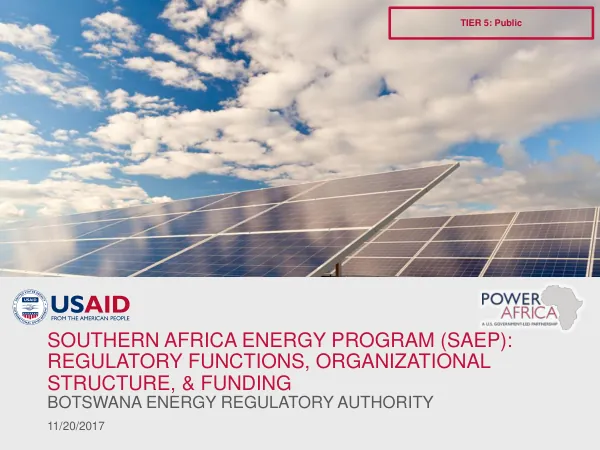
SOUTHERN AFRICA ENERGY PROGRAM (SAEP): REGULATORY FUNCTIONS, ORGANIZATIONS, & FUNDING
Sign inUSAID DEC
SOUTHERN AFRICA ENERGY PROGRAM (SAEP): REGULATORY FUNCTIONS, ORGANIZATIONS, & FUNDING
The Southern Africa Energy Program (SAEP) emphasizes the importance of effective regulatory authorities in the energy sector.
2020 · 33 pages
Sign in to readA free account is required to download.
Abstract
Attributes of such authorities include independence, accountability, transparency, and clarity of roles and rules. These attributes enable regulatory bodies to make decisions that promote fair competition, ensure public safety, and protect the environment. Independence is a critical attribute of regulatory authorities, as it allows them to operate free from political interference. This can be achieved through the establishment of a separate regulatory body with its own governing board and staff. The board and staff should be responsible for making decisions and taking actions that are in the best interest of the public, rather than being subject to the whims of government officials. The regulatory authority's organizational structure is also crucial in ensuring its independence. A clear separation of powers between the regulatory body and the government is essential. This can be achieved through the establishment of a separate regulatory body with its own governing board and staff, as well as a clear definition of the regulatory functions and powers. Funding is another critical aspect of regulatory authorities. Regulatory bodies require sufficient funding to carry out their functions effectively. However, the funding mechanism should be transparent and free from political influence. In some cases, regulatory bodies may be funded through a combination of government appropriations and private sector contributions. A case study on gaining trust highlights the importance of transparency and public participation in building trust between regulatory authorities and the public. Regulatory bodies should engage with the public and stakeholders to ensure that their decisions are informed by the needs and concerns of the community. This can be achieved through public consultations, stakeholder engagement, and transparent decision-making processes. The regulatory authority's framework should be designed to promote transparency, accountability, and public participation. This can be achieved through the establishment of clear rules and procedures, as well as regular reporting and evaluation of the regulatory body's performance. The regulatory authority should also be free from political interference and should have the necessary powers to carry out its functions effectively. Examples of regulatory authorities in Tanzania and the United States highlight the importance of independence and separation of powers. In Tanzania, the Energy and Water Regulatory Authority is part of the Ministry of Water, but has some degree of independence in carrying out its regulatory functions. In the United States, the Federal Energy Regulatory Commission is a separate regulatory body with its own governing board and staff, and is responsible for regulating the energy sector. In conclusion, effective regulatory authorities are critical in promoting fair competition, ensuring public safety, and protecting the environment. The attributes of independence, accountability, transparency, and clarity of roles and rules are essential in ensuring that regulatory bodies operate effectively and efficiently. The regulatory authority's organizational structure, funding mechanism, and framework should be designed to promote transparency, accountability, and public participation.
Related documents