USAID DEC
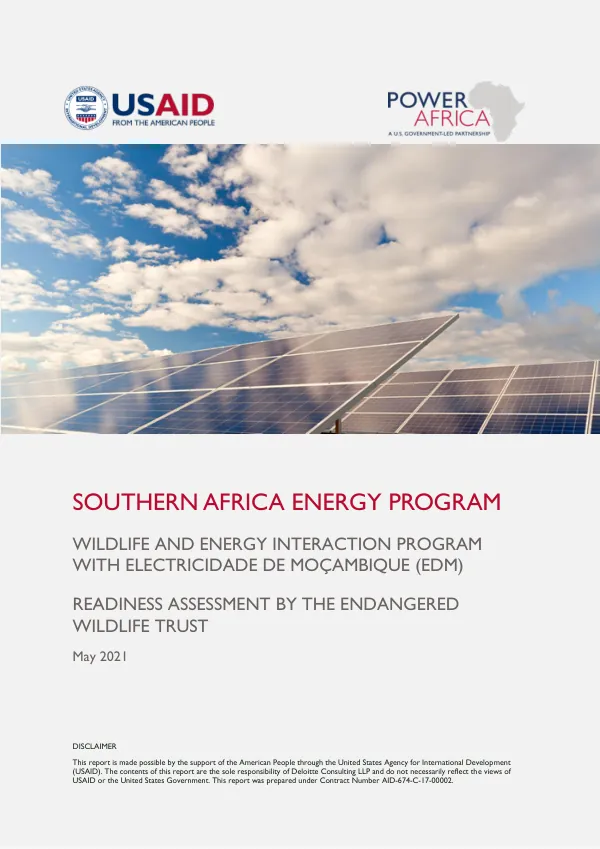
Southern Africa Energy Program: Wildlife and Energy Interaction Program with Electricidade de Moçambique (EDM) Readiness Assessment by the Endangered Wildlife Trust
Sign inDELOITTE CONSULTING, LLP
Southern Africa Energy Program: Wildlife and Energy Interaction Program with Electricidade de Moçambique (EDM) Readiness Assessment by the Endangered Wildlife Trust
The Southern Africa Energy Program (SAEP) Wildlife and Energy Interaction Program, conducted in collaboration with Electricidade de Moçambique (EDM), aimed to assess the readiness of EDM to implement a Wildlife Management System (WMS) to improve the quality of supply through the management of wildlife interactions.
2021 · 39 pages
Sign in to readA free account is required to download.
Abstract
The program was made possible by the support of the American People through the United States Agency for International Development (USAID). The assessment was conducted by the Endangered Wildlife Trust (EWT) in May 2021, following an online engagement with EDM earlier in the year. The EWT team traveled to Mozambique to meet with EDM staff and inspect electrical infrastructure in the field. The assessment focused on the implementation of a WMS to mitigate wildlife interactions with electrical infrastructure, which were causing severe outages along the network. The EWT team inspected several distribution and transmission terminating structures, feeders, towers, and substations, and discussed solutions to improve line performance in the field. An assessment of the general power line design, avifauna recorded, and habitat was conducted. A readiness assessment was also completed through a survey sent out to EDM in advance and face-to-face engagement with environmental staff and line engineers. The assessment revealed several key issues, including the need for EDM to improve its understanding of species causing faults, why these faults occur, mitigation solutions available, and how structure design and routing is the first step in the decision-making process. The assessment also highlighted the importance of engaging at a higher level (project funders) to address new infrastructure projects and the need for reactive mitigation solutions to be implemented by the utility itself. Based on the assessment findings, several recommendations were made to EDM, including influencing the preferred structure design for voltage up to 33kV, reconsidering the concrete pole replacement strategy, and insulating exposed bushings and jumpers on strain poles and transformers. The recommendations also included deploying bird flight diverters, starting the data collection process, and improving the capacity of environmental staff. The next steps for EDM include integrating wildlife management into the utility by developing a legacy document and providing in-country training and continuous support to ensure full integration of the system throughout the business. In-country training and awareness to utility and NGO staff, as well as continuous support to utilities and building capacity of in-country NGOs to assist utilities with wildlife interactions, are also recommended. The implementation of a WMS is crucial for EDM to improve the quality of supply and reduce the impact of wildlife interactions on the electrical infrastructure. The assessment findings and recommendations provide a roadmap for EDM to improve its understanding of wildlife interactions and implement effective mitigation measures to minimize the impact of these interactions on the electrical infrastructure.
Related documents