DELOITTE CONSULTING, LLP
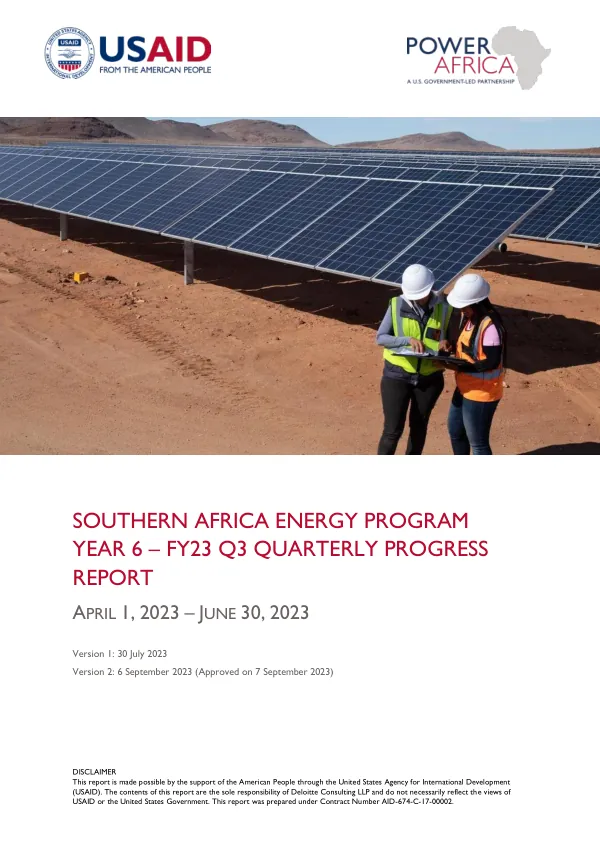
Southern Africa Energy Program Year 6 – FY23 Q3 Quarterly Progress Report
The Southern Africa Energy Program (SAEP) is a USAID-funded initiative aimed at promoting energy sector development in the Southern African region.
2023 · 124 pages
Sign in to readA free account is required to download.
Abstract
The program began in 2017 and is set to conclude in June 2024. As of June 30, 2023, the program has achieved significant progress in various areas. One of the key performance indicators (KPIs) for the program is the number of new grid connections or off-grid connections. As of June 30, 2023, the program has achieved 101.06% of the target, with 3,031,949 new connections made. The program also aims to mobilize investment for energy projects, with a target of $8,134.8 million. As of June 30, 2023, the program has mobilized $6,778.8 million, representing 83.33% of the target. The program has also made significant progress in reducing greenhouse gas emissions. As of June 30, 2023, the program has achieved 95.24% of the target, with 4,168,180 tons of CO2e reduced. Additionally, the program has implemented various initiatives to enhance energy sector governance, with 132.26% of the target achieved in terms of laws, policies, and regulations proposed, adopted, or implemented. The program has also made progress in improving the capacity of institutions in the energy sector. As of June 30, 2023, the program has achieved 129.51% of the target, with 79 institutions improved. Furthermore, the program has implemented various initiatives to promote energy efficiency, with 963% of the target achieved in terms of GJ of electricity saved. The program has also engaged with various stakeholders, including USG agencies, U.S. companies, Power Africa partners, donors, and others. The program has also facilitated the development of several renewable energy projects, including solar and wind power projects. In terms of challenges and risks, the program faces various obstacles, including regulatory and policy challenges, as well as technical and financial challenges. However, the program has implemented various mitigation strategies to address these challenges. The program has also identified opportunities for American companies to participate in the energy sector in Southern Africa. The program has facilitated the development of several investment opportunities, including the development of renewable energy projects. In conclusion, the SAEP has made significant progress in promoting energy sector development in the Southern African region. The program has achieved various KPIs, including the number of new grid connections, investment mobilization, greenhouse gas emissions reduction, and institutional capacity improvement. The program has also engaged with various stakeholders and facilitated the development of several renewable energy projects. However, the program faces various challenges and risks, which are being addressed through various mitigation strategies.