AFGHAN MINISTRY OF RURAL REHABILITATION AND DEVELOPMENT
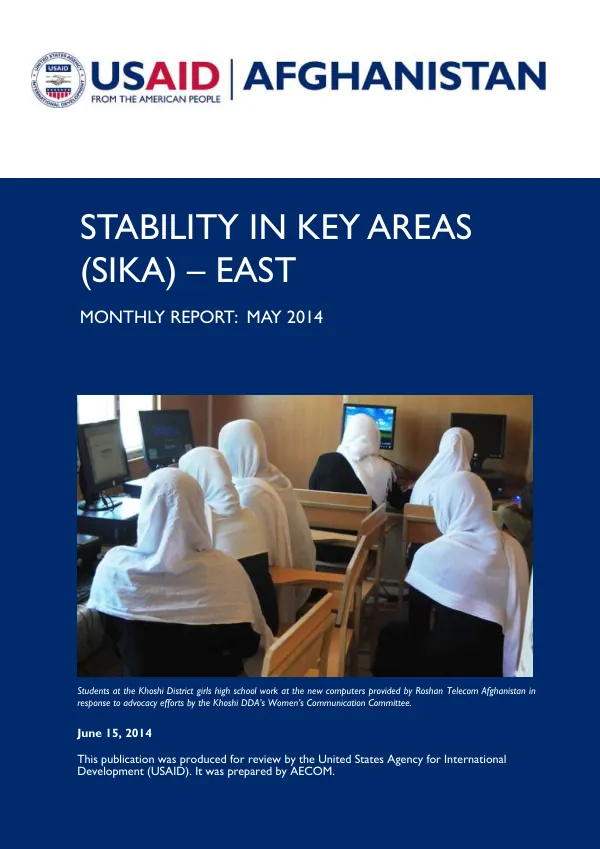
Stability in Key Areas (SIKA) - East Monthly Report May 2014
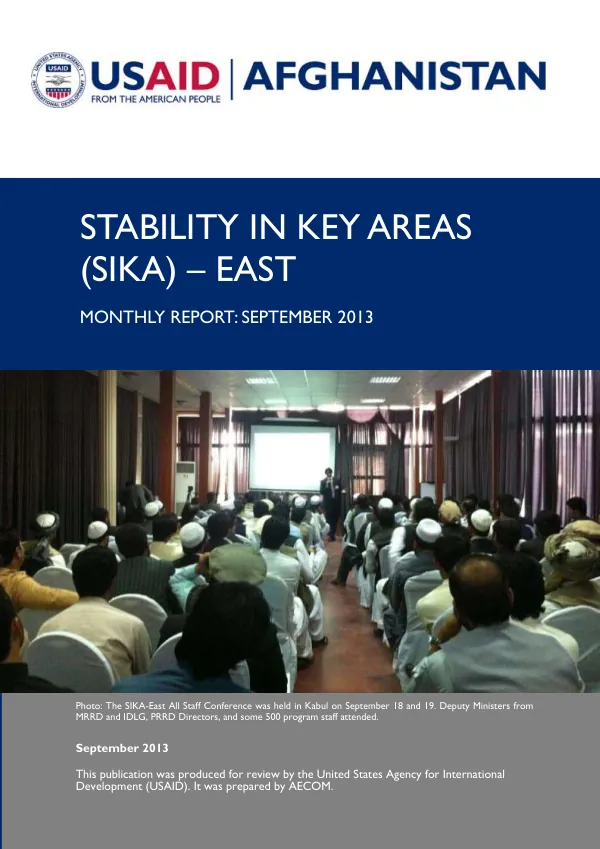
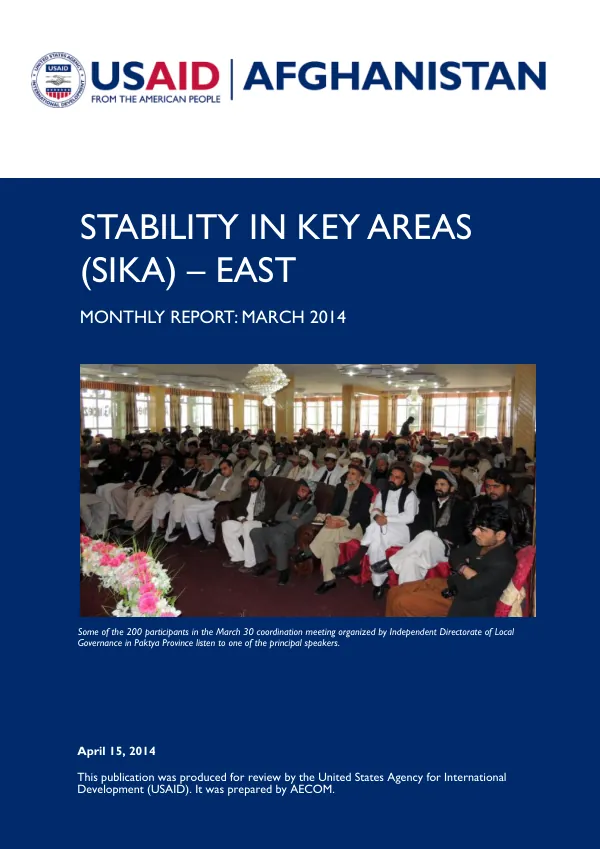
The Stability in Key Areas (SIKA) - East program is a collaborative effort between the Afghan Ministry of Rural Rehabilitation and Development (MRRD), the Independent Directorate of Local Governance (IDLG), and USAID.
2014 · 43 pages
Sign in to readA free account is required to download.
Abstract
The program aims to strengthen governance and service delivery in conflict-affected districts of southeastern Afghanistan. SIKA-East is operational in 21 originally programmed districts and has been launched in six new districts, including Muqur in Ghazni Province, Nadir Shah Kot in Khost, Maydan Shahr in Maydan Wardak, and Ali Khel, Mirzaka, and Sayed Karam in Paktya. During May 2014, SIKA-East achieved several milestones. The program launched in six new districts, bringing the total number of districts under SIKA-East to 27. A total of 14 infrastructure grants, valued at nearly $463,000, were awarded, including the first grant in the Garda Serai sub-district of Paktya Province. Additionally, 18 grant projects, valued at nearly $443,000, were completed in six districts. Capacity building sessions were conducted in 19 districts, with 699 men and 30 women trained in stability, outreach, and technical skills. Communication plan implementation meetings were held in 12 districts in Ghazni, Khost, and Maydan Wardak Provinces. The program also conducted 56 capacity building sessions, with a total of 842 trainings conducted for 18,134 men and 5,426 women (23%) since the beginning of the program. The cumulative results of the program show that 237 grants, valued at $8,367,530, have been awarded, and 117 worth nearly $4.1 million have been completed. The program has also held 1,136 coordination meetings across the districts, often resulting in successful advocacy initiatives strengthening community resiliencies. SIKA-East is working closely with expanded District Development Assemblies (DDA), or so-called DDAs Plus (DDA+), to achieve its objectives. The program is focusing on three key areas: engagement and building relationships between provincial and district entities and constituencies, improved technical capacity for good governance, and enhanced service delivery in citizen requests for interventions that improve stability. The program's life span is from December 2011 to September 2015, and it covers 29 districts in six provinces of Afghanistan's southeast. SIKA-East is fully operational in all 21 originally programmed districts and has been launched in six new districts. The transition of program activities to the Afghan government and exit strategy are planned for districts that have reached a sufficient governance maturity level and where programmatic objectives and benchmarks, agreed with MRRD and IDLG, have been reached. The primary objective of the SIKA-East program is to promote good governance and service delivery in targeted districts at sub-national level in order to promote stability and reduce the impact of the insurgency through capacity building with MRRD and IDLG. The program is working closely with the Afghan government and local stakeholders to achieve its objectives and improve the lives of the people in southeastern Afghanistan. In May 2014, SIKA-East held meetings with the Ali Khel DDA in Paktya Province to select priority projects from their District Development Plan for fast-track implementation by SIKA-East. The program is also working to launch SIKA-East in the Sharana and Yosuf Khel Districts of the newly targeted province of Paktika. The transition of program activities to the Afghan government and exit strategy are planned for districts that have reached a sufficient governance maturity level and where programmatic objectives and benchmarks, agreed with MRRD and IDLG, have been reached. The program's progress toward immediate outcomes is being closely monitored, and the results are being reported on a regular basis. The program's achievements and challenges are being documented and analyzed to ensure that the program is meeting its objectives and making a positive impact on the lives of the people in southeastern Afghanistan.