AFGHAN MINISTRY OF RURAL REHABILITATION AND DEVELOPMENT
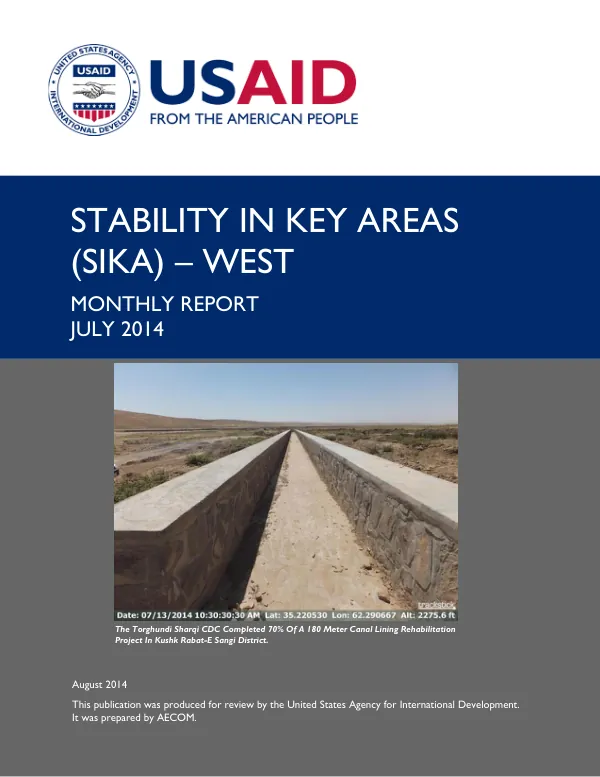
Stability In Key Areas (SIKA) – West / Monthly Report – July 2014
The Stability in Key Areas (SIKA) – West program is a USAID-funded initiative aimed at promoting stability in key areas of Afghanistan.
2014 · 18 pages
Sign in to readA free account is required to download.
Abstract
The program is led by AECOM International Development and is implemented in collaboration with the Ministry of Rural Rehabilitation and Development (MRRD) and the Independent Directorate of Local Governance (IDLG). The program's primary objective is to assist provincial authorities and district-level government entities in improving government performance in the area of stabilization programming and providing priority basic services to increase citizen confidence in and support for the Government of the Islamic Republic of Afghanistan (GIRoA). The program is active in four provinces: Farah, Badghis, Herat, and Ghor, covering a total of 16 districts. The program's phased provincial rollout began in January 2012 and is expected to continue until August 2015. The program's 18-month extension period will see the addition of six new districts to the existing 10 target districts. During the month of July 2014, the program's stabilization department provided training to the Bala Boluk District Governor on how to write a "Stabilization Snapshot." The SIKA-West Stabilization Department will mentor and assist the District Governments to record "Stabilization Snapshots" where local government support has been provided to individual communities to address their major concerns. These stories will be shared with the program's stakeholders to highlight the successes and challenges of the program. The program's community development department has been actively engaged in various activities, including the provision of conflict resolution skills training to 30 members of the Tribal Conflict Resolution Committee (TCRC) in Guzara District on July 2nd. The program's communications department has also been working on various initiatives, including the development of a Service Providers Catalog (SPC) to facilitate the provision of basic services to the local population. The program's governance department has been working closely with the MRRD and IDLG partners to support the district and provincial governments in improving their performance in the area of stabilization programming. The program's gender mainstreaming unit has also been actively engaged in promoting gender equality and women's empowerment in the program's target areas. The program's monitoring and evaluation department has been tracking the program's progress and identifying areas for improvement. The department has also been working on developing a Stability Analysis Mechanism (SAM) to assess the program's impact on stability in the target areas. Overall, the SIKA-West program has made significant progress in promoting stability in key areas of Afghanistan. The program's activities have been focused on improving government performance, providing priority basic services, and promoting gender equality and women's empowerment. The program's extension period will see the addition of six new districts to the existing 10 target districts, which will further enhance the program's impact on stability in the region.