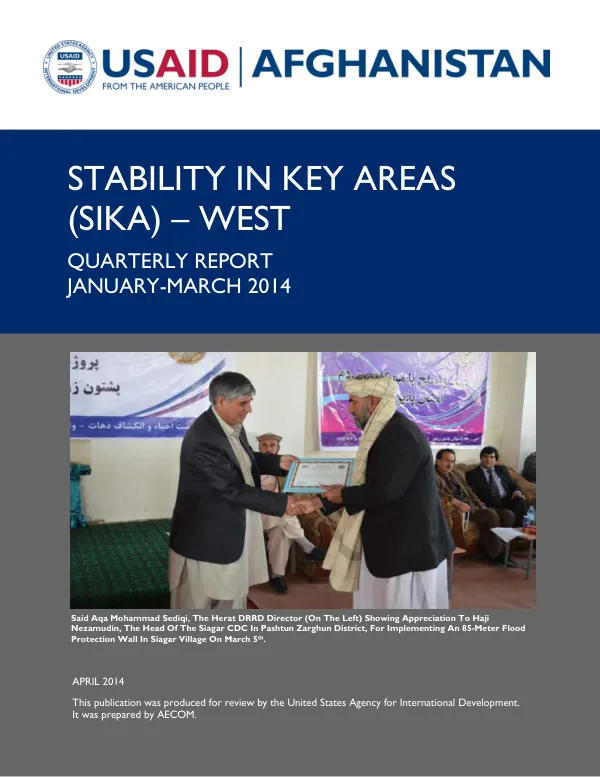
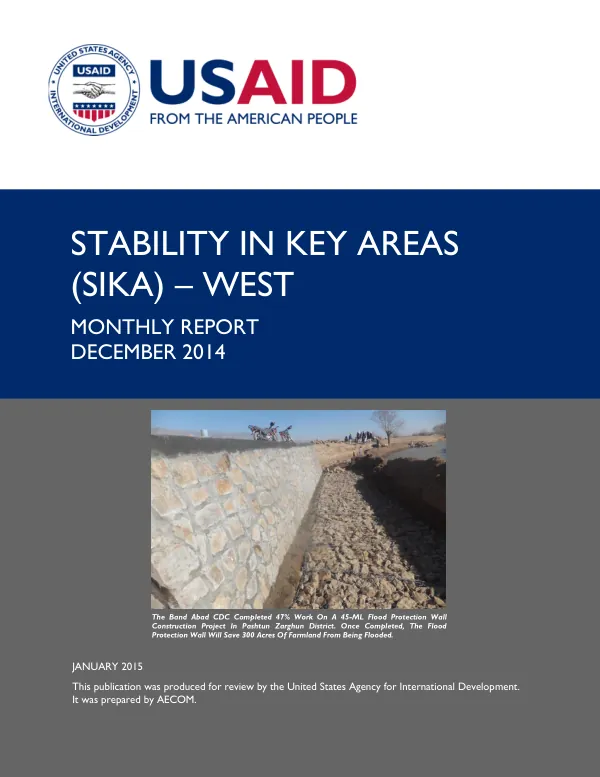
AFGHAN MINISTRY OF RURAL REHABILITATION AND DEVELOPMENT
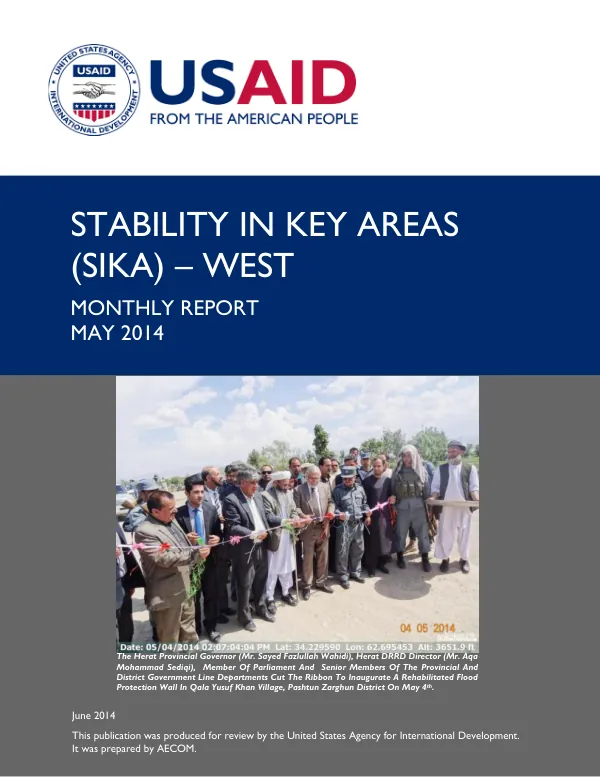
Stability In Key Areas (SIKA) – West / Monthly Report – May 2014
The Stability in Key Areas (SIKA) – West program is a USAID-funded initiative aimed at increasing stability within targeted regions in western Afghanistan.
2014 · 27 pages
Sign in to readA free account is required to download.
Abstract
The program is led by the Ministry of Rural Rehabilitation and Development (MRRD) and the Independent Directorate of Local Governance (IDLG), in partnership with USAID. The SIKA-West program is active in four provinces: Farah, Herat, Badghis, and Ghor, covering 14 districts. During the month of May 2014, 14 GIRoA-led Komite Sobate Woleswali (District Stabilization Committee) meetings were held in various districts. These meetings brought together district government line departments, district development assembly members, community development council members, DRRD district social workers, tribal leaders, religious scholars, and district residents. The meetings provided a platform for discussing district stabilization and development issues. In addition to the general Komite Sobate Woleswali meetings, separate meetings were held for women in culturally sensitive districts. These meetings were held in Du Layna, Pusht-e Rod, and Bala Boluk, and provided a platform for women to share their concerns and advocate for their needs. The SIKA-West program focuses on stabilization programming, communications programming, community development programming, governance programming, and gender mainstreaming. The program aims to support district and provincial GIRoA authorities in increasing stability within targeted regions, paving the way for future government-led development. The program's geographic focus is on the four provinces of Farah, Herat, Badghis, and Ghor, covering 14 districts. The program's implementation details include the establishment of district stabilization committees, community development councils, and district support teams. The program also focuses on infrastructure development, market linkage facilitation, and farmer training programs. The SIKA-West program has made significant progress in improving stability and security in the targeted regions. The program's success can be attributed to the strong partnership between the MRRD, IDLG, and USAID. The program's leadership and coordination have been instrumental in ensuring the effective implementation of the program's activities. The program's focus on stabilization programming, communications programming, community development programming, governance programming, and gender mainstreaming has also contributed to its success. The SIKA-West program's lessons learned highlight the importance of community engagement and participation in the program's activities. The program's experience in conducting separate meetings for women in culturally sensitive districts has shown that this approach can be effective in empowering women and addressing their concerns. The program's focus on infrastructure development, market linkage facilitation, and farmer training programs has also been successful in improving stability and security in the targeted regions. Overall, the SIKA-West program has made significant progress in improving stability and security in western Afghanistan. The program's strong partnership, effective leadership, and focus on community development and stabilization programming have contributed to its success.