AFGHAN MINISTRY OF RURAL REHABILITATION AND DEVELOPMENT
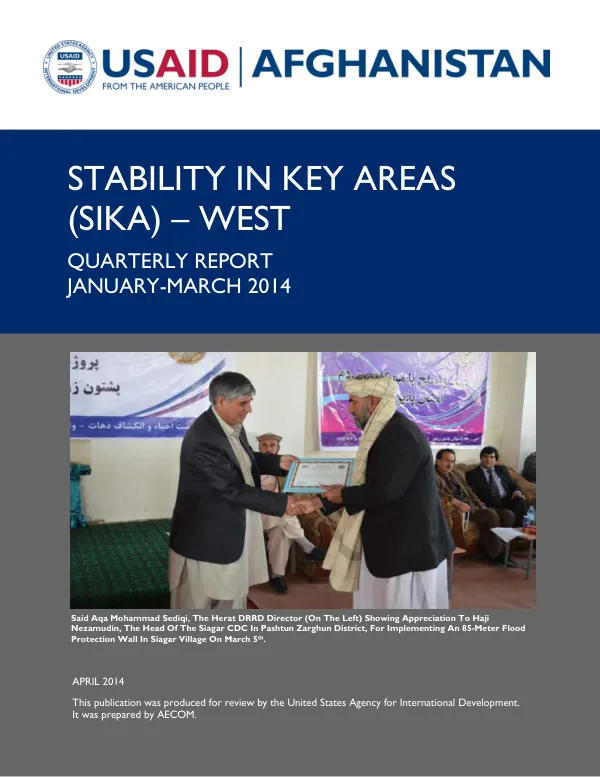
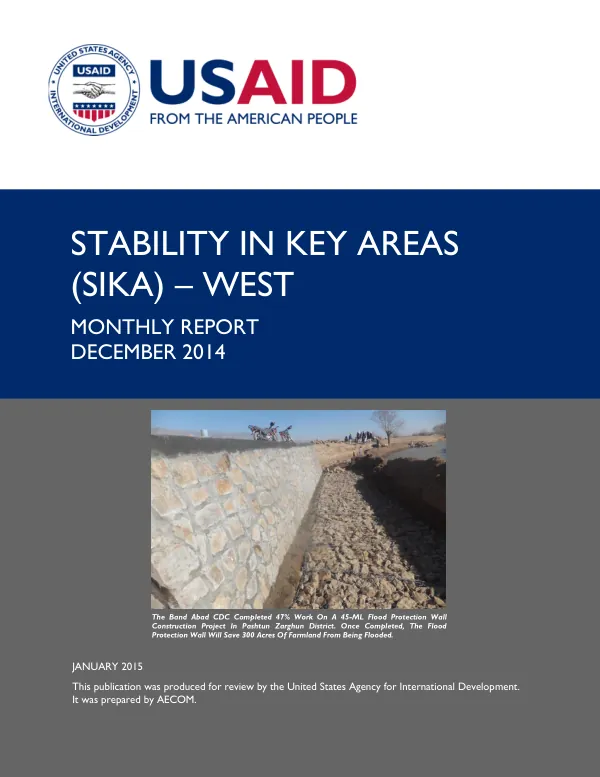
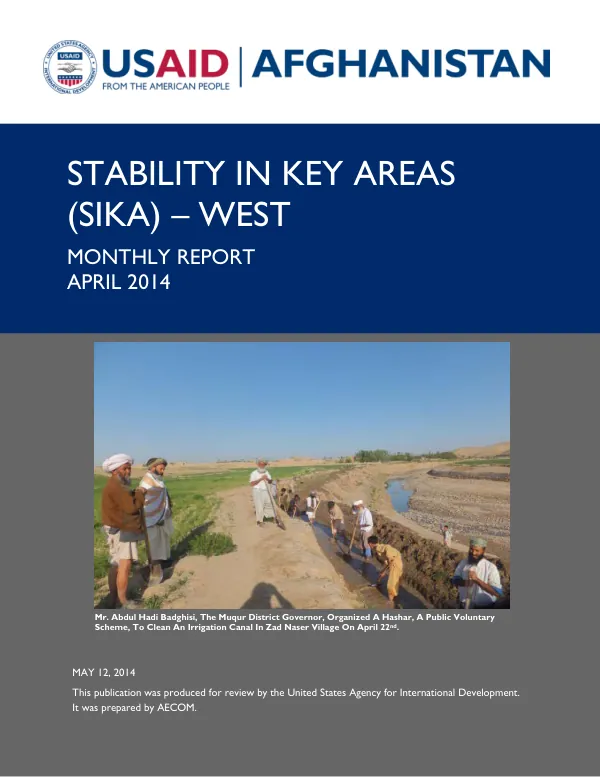
Stability In Key Areas (SIKA) – West / Monthly Report – April 2014
The Stability in Key Areas (SIKA) – West program is a USAID-funded initiative aimed at increasing stability within targeted regions in western Afghanistan.
2014 · 22 pages
Sign in to readA free account is required to download.
Abstract
The program is led by the Ministry of Rural Rehabilitation and Development (MRRD) and the Independent Directorate of Local Governance (IDLG) in partnership with USAID. The program is active in four provinces: Farah, Herat, Badghis, and Ghor, covering 12 districts. During the month of April 2014, eight Komite Sobate Woleswali meetings were held in various districts to identify and discuss community major problems, including seasonal floods, unemployment, water disputes, and illiteracy. Participants included district government line departments, district development assembly members, community development council members, district social workers, tribal leaders, religious scholars, and district residents. The meetings provided an opportunity to prioritize solutions that may be addressed by available government resources, including road, flood protection walls, and community center rehabilitation. In addition to the Komite Sobate Woleswali meetings, separate meetings were held for women in culturally sensitive districts to share their concerns and advocate for their needs. The women identified unemployment, lack of education, and insecurity as community major problems and proposed to renovate a girl's school in Massow village. District government-led Tribal Conflict Resolution Committees (TCRCs) and Conflict Resolution Committees (CRCs) for women addressed conflicts utilizing existing government resources. In Kushk Rabat-e Sangi, a conflict between Mr. Jalaledin and his daughter's husband was mediated by the Pashtun Zarghun TCRC. The conflict started five months ago when Mr. Jalaledin's daughter died, and he accused her husband of having a hand in her death. The TCRC mediated between the conflicting parties, and Mr. Jalaledin eventually accepted that there was a misunderstanding and that his daughter's husband was innocent. In Khak-e-Safayd, a conflict between two farmers, Abdul Basir and Abdul Mutaleb, was addressed by the TCRC. The two farmers were unable to agree on a shared schedule to draw irrigation water from the village canal. Each one accused the other of using more than their allotted amount. The TCRC stepped in to mediate and obtained an acknowledgement from the farmers that the water was not being equally shared and that both would hold to an agreement ensuring they would both receive equal amounts. In Qadis, a conflict between Mr. Raees Shah Mohammad and Mr. Hamidullah was addressed by the TCRC. The conflict involved a dispute over a shared irrigation canal, and the TCRC mediated between the two parties, obtaining an agreement to share the water equally. The SIKA-West program is focused on supporting district and provincial GIRoA authorities to increase stability within targeted regions, paving the way for future government-led development. The program is led through the MRRD and IDLG, in partnership with USAID, and is active in four provinces and 12 districts. The program's activities include stabilization programming, communications programming, community development programming, governance programming, and cross-cutting capacity building. The program's progress is monitored and evaluated through various mechanisms, including the Stability Analysis Mechanism (SAM) and the Measuring Impacts of Stabilization Initiatives (MISTI) framework.