USAID DEC
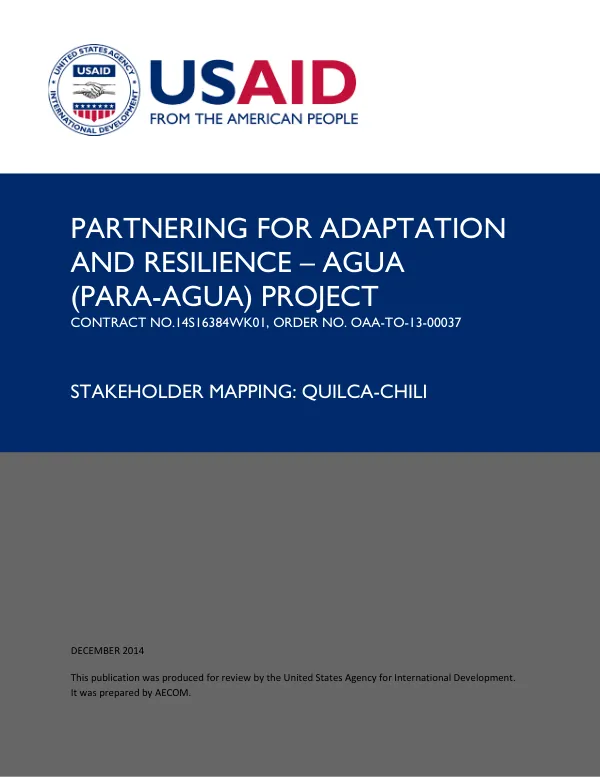
Stakeholder Mapping: Quilca-Chili - Partnering for Adaptation and Resilience – Agua (PARA-Agua) Project
Sign inAECOM INTERNATIONAL
Stakeholder Mapping: Quilca-Chili - Partnering for Adaptation and Resilience – Agua (PARA-Agua) Project
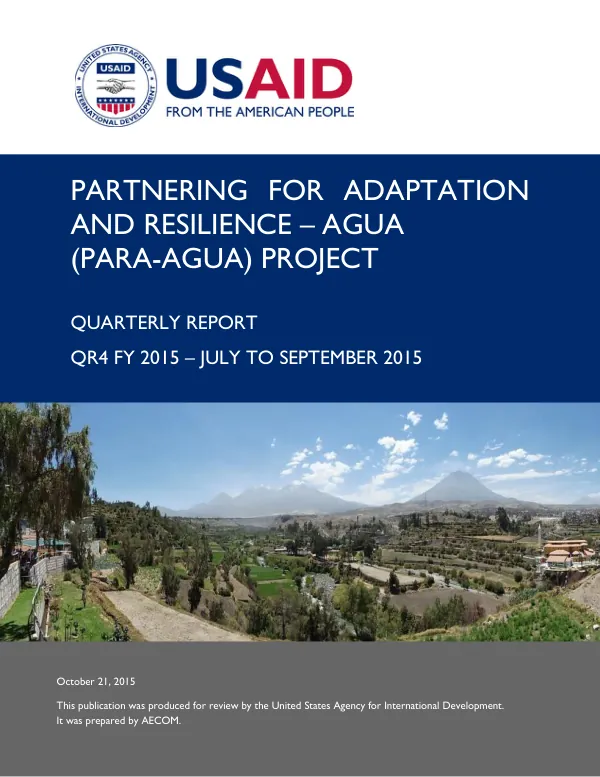
The PARA-Agua project, a partnership for adaptation and resilience in the Quilca-Chili watershed, was initiated to strengthen planning systems that optimize water use in the context of climate change adaptation.
2014 · 22 pages
Sign in to readA free account is required to download.
Abstract
The project's task 3 focused on strengthening planning systems, and a network analysis was conducted among stakeholders to identify, describe, and analyze the links of the different actors in the basin. The network analysis used the software NetDraw to create maps visualizing the survey responses. Each map illustrates a different survey question but contains nodes representing all the institutions interviewed and the institutions they named. The unconnected nodes are stacked on the left, and Netdraw determines each node's position in a map by its relationships, with the more connected nodes placed towards the center. The analysis revealed that the National Water Authority (ANA), which includes the Modernization Project (PMGRH), is a central actor in the watershed through its interactions with various basin actors. This suggests that PARA-Agua can partner with ANA to solicit and encourage watershed institutions to participate in the project's activities. The network analysis also showed that women are underrepresented in the water resources management field, with less than 50% of employees in all divisions and less than 35% in leadership roles. This indicates that voices in water resources management can be further diversified to capture women's perspectives. The Quilca-Chili watershed's social networks identified links between local organizations according to their interests in water resources management. These links can guide PARA-Agua's task 3.2 framing of opportunities, objectives, and methodologies for management and innovation to address the watershed challenges of the future jointly with the CRHC Quilca Chili. The project's stakeholder mapping involved conducting 20 interviews with representatives from local organizations involved in water management in the Quilca-Chili watershed. The interviews examined how each organization characterized its activities in the basin and the activities of the organizations that it interacted with in the course of its work. The survey also asked for additional organizational links the interviewees would like to support their work. The project's stakeholder mapping also involved examining the participation of women in the management of the resources of the water in the different activities by numbers of women involved in each interviewee institution. With the help of a gender specialist, PARA-Agua also communicated with the Regional Federation of Rural communities in the Woman's Secretariat (Secretaria de la Mujer), but due to logistical constraints they could not participate in the survey. The network analysis for the Quilca-Chili watershed identified links between local organizations according to their interests in water resources management. These links can guide PARA-Agua's task 3