MINISTRY OF THE ENVIRONMENT
Why Gender Equality is at the Heart of Our Water Security Strategy in Peru
Peru is one of the world's most vulnerable countries to the impacts of climate change, with water security being a critical concern.
2020 · 7 pages
Sign in to readA free account is required to download.
Abstract
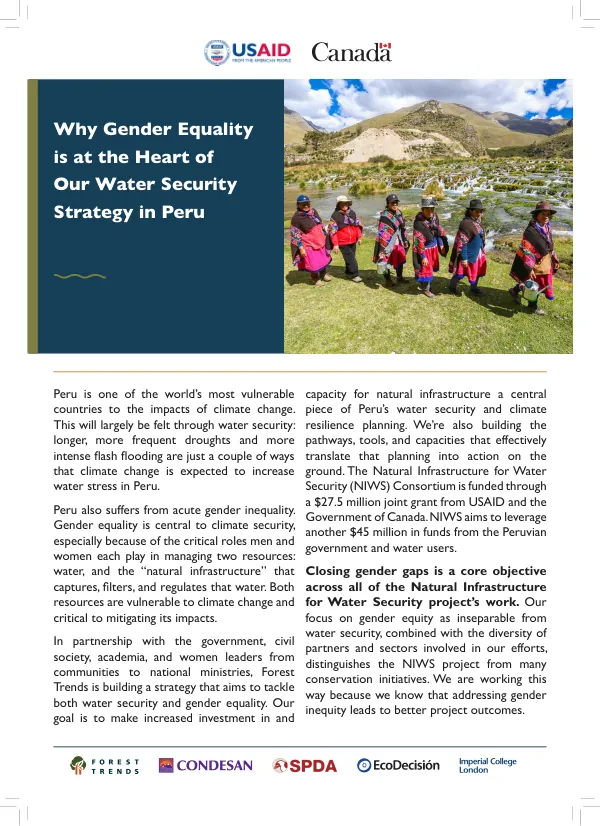
Climate change is expected to increase water stress through longer, more frequent droughts and intense flash flooding. Peru also faces acute gender inequality, with women playing a crucial role in managing water resources and natural infrastructure. The critical roles men and women each play in managing water and natural infrastructure make gender equality central to climate security. In Peru, women are the main users of water for domestic consumption, subsistence agriculture, family care, and basic sanitation. However, they have few opportunities to participate in water-related decision-making. A gender gap assessment by Forest Trends shows that men and women share the overall responsibility of maintaining natural infrastructure and water resources, but women typically bear primary responsibility for providing water for their families and performing water-related household tasks. Despite these contributions, women are rarely adequately represented or involved in water and natural infrastructure-related decision-making. Men from high Andean communities have been increasingly traveling to urban areas for seasonal work to supplement family incomes. In their absence, women have assumed roles traditionally held by men, including upkeep of natural infrastructure, in addition to their existing responsibilities in the home. Women face substantial barriers to participation in decision-making on water at all levels, including less access to formal education, higher rates of illiteracy, and expectations to perform more unpaid labor than men. The gap in participation in decision-making is due to disparities in land ownership, with women holding only 22% of agricultural land titles in Peru. This disparity in land ownership also has important consequences for employment and wealth generation. There are opportunities to improve female representation in water and natural infrastructure management, and the NIWS project and partners in key government institutions will continue to identify and overcome barriers to women's participation in decision-making. The NIWS project has secured institutional commitments from Peru's leading national water agencies to mainstream a gender approach and address gender gaps in the water sector. These commitments have led to the first regulation to explicitly consider gender, issued by SUNASS in November 2019. Forest Trends and partners have kicked off the development of comprehensive institutional assessments and Gender Action Plans in ANA and SUNASS, with specialized consulting teams and task forces in each institution. Peru's Ministry of Women and Vulnerable Populations is a key partner and is tasked with mainstreaming gender in all national authorities and local and regional governments. With Forest Trends' support, the water sector is one of the first to tackle this challenge. The Gender and Water Security Forum in June 2019 recognized 20 women leaders working for water security in Peru, marking the first time that women's leadership in the water sector was explicitly recognized and valued at a national level by the government. The NIWS project has also launched a Women's Leadership Program for Water Management in June 2020 to support 88 women leaders across multiple sectors by offering training to increase their technical, leadership, and leadership skills. The program is currently in its initial stages due to the COVID-19 pandemic. Forest Trends and partners have worked closely with the Ministry of Environment to ensure that a representative of women's organizations will be involved in the development of the National Water Plan. The NIWS project aims to leverage $27.5 million in joint funding from USAID and the Government of Canada to support the implementation of a combined infrastructure approach that prioritizes natural infrastructure. The project will also focus on increasing investment in and capacity for natural infrastructure, as well as building pathways and capacities that effectively translate planning into action on the ground. The project's goal is to improve water security and reduce the impacts of climate change in Peru.