USAID DEC
Standard Operating Procedures (SOP) for Organizing and Conducting Cooking Demonstrations
Sign inSAVE THE CHILDREN FUND
Standard Operating Procedures (SOP) for Organizing and Conducting Cooking Demonstrations
The ENGINE program, a joint initiative under the Global Health Initiative and Feed the Future Initiative, aims to empower new generations to improve nutrition and economic opportunities.
2016 · 10 pages
Sign in to readA free account is required to download.
Abstract
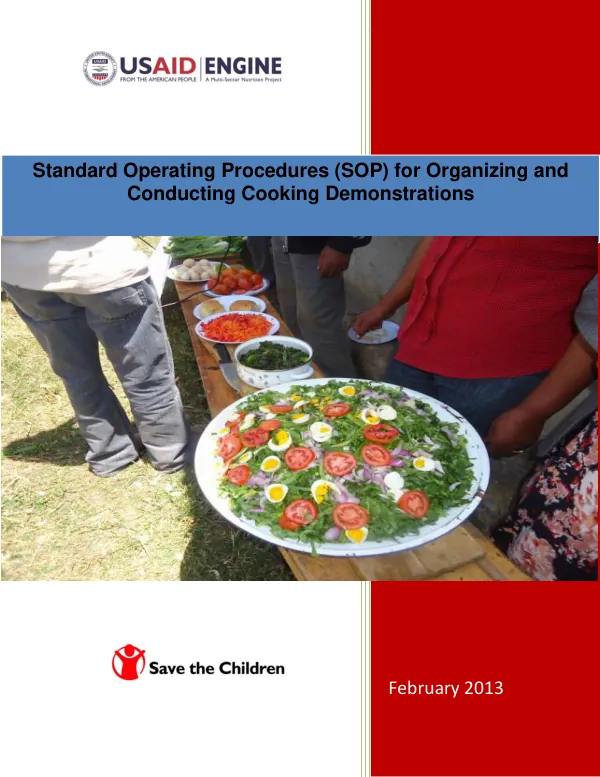
The program is supported by the United States Agency for International Development (USAID) under Agreement No. AID-663-A-11-0001. Cooking demonstrations are a key strategy for promoting optimal feeding practices, particularly among mothers, grandmothers, fathers, and other community members. These demonstrations involve facilitating the preparation of diversified and locally available food that is of appropriate consistency and amount required for infants, children, and adults. The purpose of conducting cooking demonstrations is to transfer knowledge and skills to participants about how to prepare food that is diversified and of appropriate consistency and amount for infants, children, and adults. Additionally, these demonstrations aim to influence community members to practice optimal infant and young child feeding practices. To organize and conduct a cooking demonstration, several preparations are necessary. These include ensuring that all utensils are available, making soap or ash, clean water, and a clean cooking area available, and preparing a recipe that contains at least four of the six food groups plus iodized salt. Participants are advised to bring different food groups from themselves, and effort should be made to avail animal source foods and fruits and vegetables during each cooking demonstration. The focus of cooking demonstrations in the ENGINE program is to promote optimal maternal, infant, and young child feeding practices. Major focus is given to women with children of 6-23 months of age, pregnant women, health extension workers, development army heads, health center staff, and agriculture development agents. When conducting a cooking demonstration, the role of ENGINE or government staff should be only facilitation, and participants should practice cooking by themselves. A facilitator should exercise several roles before and after the cooking demonstration, including welcoming participants, explaining the process, and informing participants about the importance of hand washing and using clean utensils and surfaces. Cooking demonstrations can be conducted at various locations, including health centers, farmers' training centers, schools, under trees, in farmers' houses, or any other place. The location should be clean, have a clean water supply, be easily accessible for participants, and be able to accommodate participants without disturbance. Different types of foods can be prepared during cooking demonstrations, but the recipe should be either for children 6-23 months of age or pregnant or lactating women. In a cooking demonstration promoted by development agents as part of nutrition-sensitive agriculture, the food to be prepared should be a family food. The ENGINE program aims to standardize the way cooking demonstrations are conducted to ensure that they are effective in promoting optimal feeding practices. This standard operating procedure (SOP) is developed to serve as a guidance for conducting cooking demonstrations at different places and occasions.
Related documents