USAID DEC
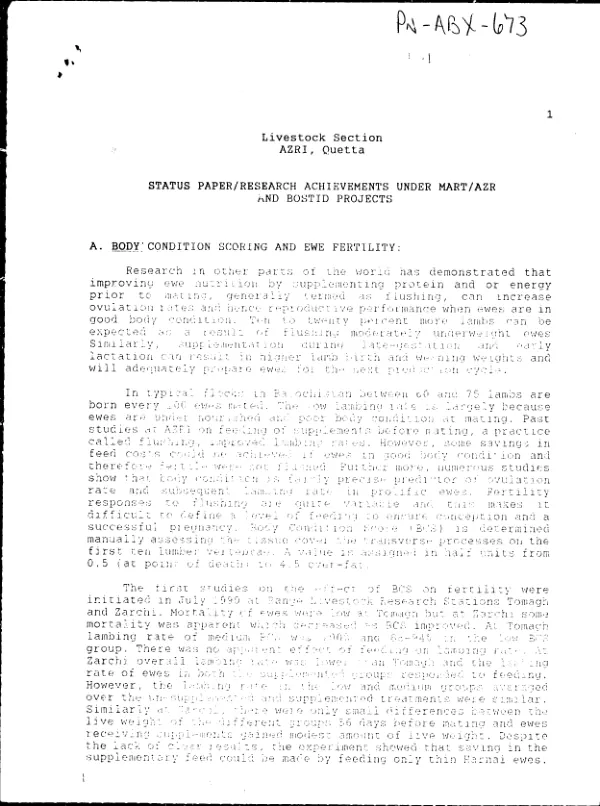
STATUS PAPER/RESEARCH ACHIEVEMENTS UNDER MART/AZR HND BOSTID PROJECTS
Livestock Section at AZRI, Quetta, has conducted research under the MART/AZR and BOSTID projects.
2010 · 6 pages
Sign in to readA free account is required to download.
Abstract
One of the key areas of focus has been body condition scoring and ewe fertility. Research has demonstrated that improving the body condition of ewes prior to mating can increase ovulation rates and improve fertility. Ewes in good body condition are more likely to be in good reproductive health. Studies have shown that ewes in the low and medium body condition scoring (BCS) groups may need to be fed. The fertility of Harnai and Balochi ewes has been influenced by differences in BCS and supplementation during mating. Research has continued at both the state and private farms, with trials conducted at Tohagh and Zarchi. The results have shown that ewes in the low BCS group had a lower lambing rate compared to those in the medium BCS group. The study on lamb fattening has highlighted the challenges faced by small ruminants in Balochistan, which mainly depend on poorly managed rangelands and sparsely available crop residues. This poor underlying nutrition makes it extremely difficult to carry even the most basic expectations in terms of production. A fattening trial was conducted at the Rae-vestock Research Station, Zarchi, on Balochi lambs 5-6 months old. The lambs were divided into four groups: semi-intensive, intensive, and extensive management systems. The results of the study showed that the lambs fed on a ration containing 12% and 17% crude protein gained equally well up to 10 months of age. A trial was also conducted involving 32 male lambs (16 Balochi and 16 Harnai) about four to five months old at ANRU, Quetta, during September and December 1991. The results showed that the lambs fed on a ration containing 12% and 17% crude protein gained equally well up to 10 months of age. Monitoring the management practices and animal performance in farm animals has been a key area of focus at AZRI, Quetta. Studies conducted over the last 3-4 years at the two Range-Livestock Production Stations at Zarchi and Tomagh have shown that improved nutrition and management of ewes during their breeding cycle improves ewe fertility, growth rate, and reduces ewe and lamb mortality. However, the comparisons made so far have been based on information collected through surveys without control treatments that are not true representatives of local flocks.