INTERNATIONAL FOOD AND POLICY RESEARCH INSTITUTE
Stocktaking: Agriculture Degree Programs in Nepal
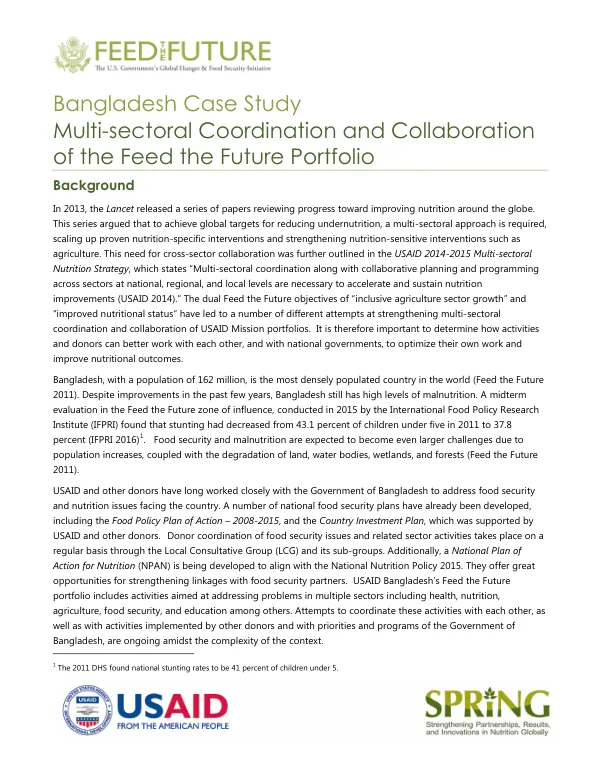
The agricultural development initiative in Nepal began with the Government of Nepal's (GoN) commitment to improving the nutritional status of the population.
2012 · 11 pages
Sign in to readA free account is required to download.
Abstract
In September 2012, the GoN released its Multi-Sector Nutrition Plan (MSNP) to guide the government's investment for the period 2013-2017. The MSNP aims to reduce undernutrition among women and children through a multi-sectoral approach. The Nutrition Collaborative Research Support Program (Nutrition CRSP) conducted a stocktaking of degree programs in agriculture currently operating in Nepal. The desk review was supplemented by verifications with key staff members at different academic institutions. A range of institutions are involved in degree granting in agriculture, including Tribhuvan University's Institute of Agriculture and Animal Science (IAAS), Purbanchal University, and Himalayan College of Agricultural Sciences and Technology (HICAST). Tribhuvan University's IAAS offers a Bachelor of Science degree in Agriculture (B.Sc.Ag) with a focus on developing technically competent agricultural graduates to apply their knowledge and skills to the established and emerging needs of the agricultural sector in Nepal. The four-year B.Sc.Ag program includes core subjects in science, management, and production, as well as elective courses in areas of interest. However, only one course, applied human nutrition, is related to human nutrition. Purbanchal University offers a Bachelor of Science (Honors) degree in Agriculture (B.Sc.Ag) with a focus on agricultural advancement and experience on indigenous technology used by farmers. The four-year B.Sc.Ag program includes introductory courses in the early semesters, project works starting from the third semester, and elective courses of interest starting from the seventh semester. Students are linked with research firms, agro-industries, NGOs, and farms for an internship in the last semester. However, unlike IAAS, there are no courses explicitly linked to human nutrition. Purbanchal University also offers a Bachelor of Food Technology degree and a Bachelor of Dairy Technology degree, which aim to improve food quality and safety. The focus is on preservation, processing, packaging, distribution, and use of safe, nutritious, and wholesome food and dairy products. Both degrees offer courses in Biochemistry and Human Nutrition and Nutrition and Dietetics. HICAST, accredited by Purbanchan University, aims to develop academically and technically sound graduates to address the shortage of trained professionals in agriculture. It follows the curriculum and course offerings of Purbanchal University and has an emphasis on research and training forming various linkages with national and international institutions. Tribhuvan University's IAAS offers a 2-year Master of Science in Agriculture (M.Sc. Ag) program with a major in various specializations, including Agricultural Economics, Agricultural Extension, Entomology, Horticulture, Plant Breeding, Plant Pathology, Conservation Ecology, and Soil Science. Students must take core courses in statistical methods, crop physiology, general biochemistry, and technical writing, in addition to specialized departmental courses. Purbanchal University has recently introduced a Master of Science degree in Dairy Technology (M.Sc. Dairy Tech.) and a Master of Science degree in Meat Technology (M.Sc. Meat Tech.) offered through the Faculty of Science and Technology. The aim of these programs is to provide candidates with the technical expertise in food and dairy quality management and safety. Both are two-year programs covering food and dairy chemistry, microbiology, processing and engineering, as well as product design, development, and marketing. A course on Biochemistry and Nutrition is offered in both programs. HICAST also offers a Master of Science degree in Dairy Technology (M.Sc. Dairy Tech.) and a Master of Science degree in Meat Technology (M.Sc. Meat Tech.). Agricultural advancement is now expected not only to increase productivity and income generation but also to be sensitive to nutritional improvement of the population. There has been increasing understanding that agriculture, health, and nutrition must progress synergistically to achieve the goals of the MSNP.