ECO CONSULTING GROUP
Policy Implementation Assessment of Resilience Policy
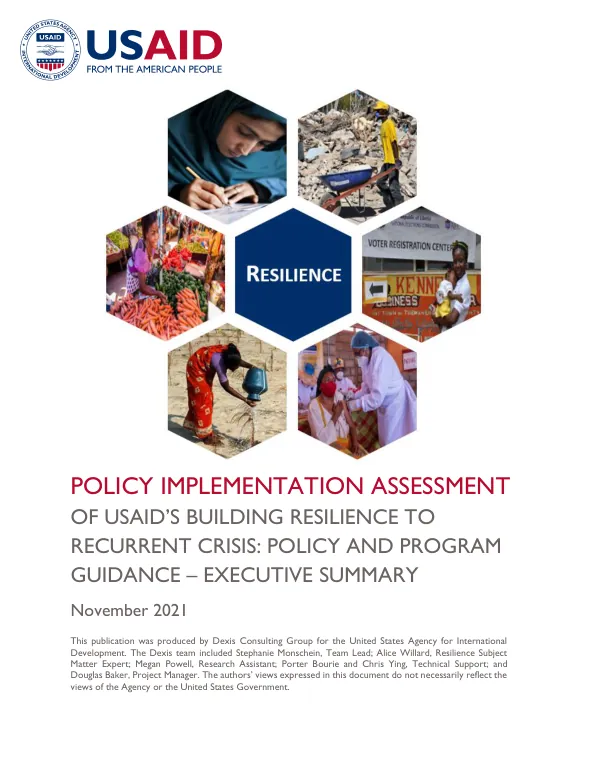
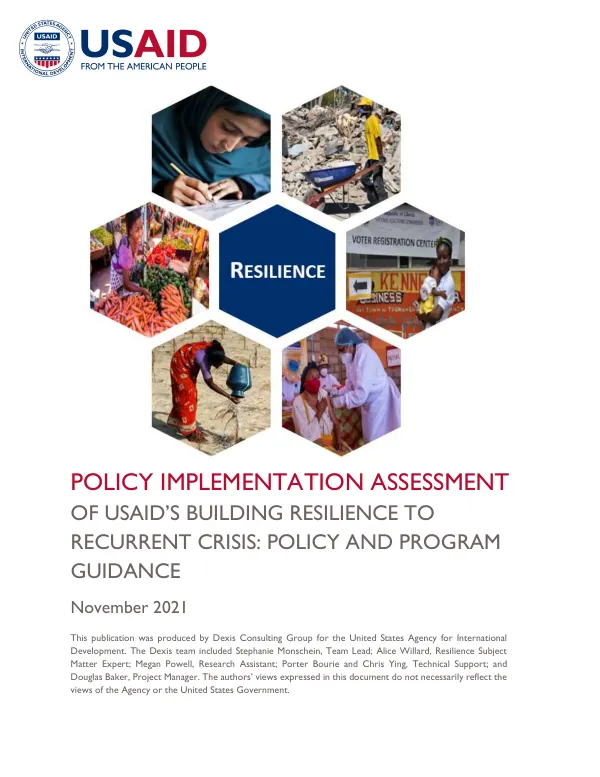
The Building Resilience to Recurrent Crisis: Policy and Program Guidance document, published in November 2021, is a comprehensive assessment of USAID's resilience policy implementation.
2021 · 59 pages
Sign in to readA free account is required to download.
Abstract
The document was produced by Dexis Consulting Group for the United States Agency for International Development. The assessment focuses on the operational agenda application through joint planning cells in the Sahel and Horn of Africa regions. Joint planning cells (JPCs) are a key mechanism for implementing the operational agenda, which aims to strengthen resilience in crisis-affected areas. The JPCs bring together USAID staff, implementing partners, and other stakeholders to develop and implement joint plans and strategies. In the Sahel region, the JPC is focused on strengthening resilience in the Sahel RISE focus zone. The JPC has established a planned timeline for implementing resilience activities, including training and capacity building for local partners, infrastructure development, and market linkage facilitation. The JPC has also established a network of local partners and stakeholders to support resilience activities. In the Horn of Africa region, the JPC is focused on strengthening resilience in the Horn of Africa Resilience Network (HoRN) zone. The JPC has established a planned timeline for implementing resilience activities, including training and capacity building for local partners, infrastructure development, and market linkage facilitation. The JPC has also established a network of local partners and stakeholders to support resilience activities. The assessment also examines the application of the operational agenda through the program cycle and humanitarian assistance in resilience focus countries. The program cycle is a key mechanism for implementing USAID's development assistance programs, and the operational agenda is integrated into the program cycle through joint planning and implementation. The evidence base for resilience is a critical component of the assessment, and the document reviews the existing evidence base for resilience, including research studies, program evaluations, and other sources of information. The assessment identifies key challenges and options for strengthening the evidence base for resilience, including the need for more research on the effectiveness of resilience interventions and the development of more robust monitoring and evaluation systems. Mainstreaming resilience is a key theme of the assessment, and the document examines the ways in which resilience is being mainstreamed into USAID's programs and operations. The assessment identifies key enablers and constraints for mainstreaming resilience, including the need for more training and capacity building for USAID staff and implementing partners, and the development of more robust institutional support structures for resilience. The assessment concludes with a set of recommendations for strengthening resilience policy and program implementation at USAID. The recommendations include the need for more training and capacity building for USAID staff and implementing partners, the development of more robust institutional support structures for resilience, and the integration of resilience into the program cycle and humanitarian assistance. Overall, the Building Resilience to Recurrent Crisis: Policy and Program Guidance document provides a comprehensive assessment of USAID's resilience policy implementation and identifies key challenges and opportunities for strengthening resilience in crisis-affected areas. The document provides a valuable resource for USAID staff, implementing partners, and other stakeholders working on resilience issues.