USAID DEC
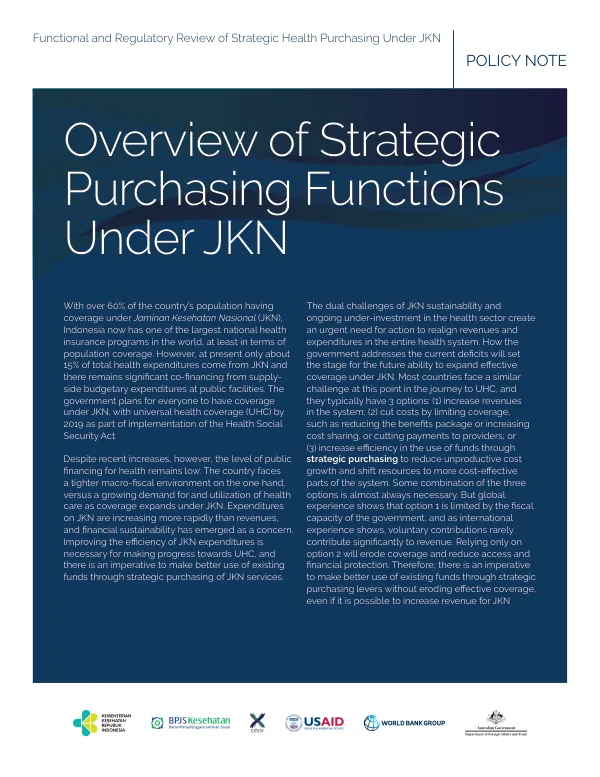
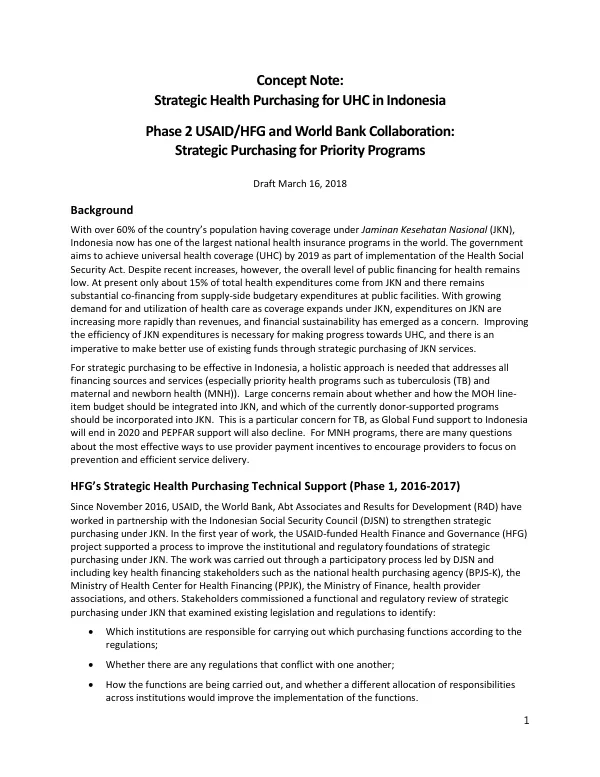
Strategic Health Purchasing for UHC in Indonesia: Phase 2 USAID/HFG and World Bank Collaboration
Sign inABT ASSOCIATES
Strategic Health Purchasing for UHC in Indonesia: Phase 2 USAID/HFG and World Bank Collaboration
The Indonesian government aims to achieve universal health coverage (UHC) by 2019 as part of the implementation of the Health Social Security Act.
2018 · 5 pages
Sign in to readA free account is required to download.
Abstract
With over 60% of the country's population covered under Jaminan Kesehatan Nasional (JKN), the largest national health insurance program in the world, the government seeks to improve the efficiency of JKN expenditures to make progress towards UHC. A holistic approach is necessary to address all financing sources and services, particularly priority health programs such as tuberculosis (TB) and maternal and newborn health (MNH). The Health Finance and Governance (HFG) project, funded by USAID, has worked in partnership with the Indonesian Social Security Council (DJSN) to strengthen strategic purchasing under JKN since November 2016. The project supported a process to improve the institutional and regulatory foundations of strategic purchasing under JKN, led by DJSN and including key health financing stakeholders. A functional and regulatory review of strategic purchasing under JKN identified a lack of clarity in the legislation and regulations supporting the implementation of JKN related to the overall responsibility for strategic purchasing. Services in priority programs such as TB and MNH have unique characteristics that distinguish them from mainstream health services and create special health financing issues. TB has a clear public health component, with consequences of failures in service delivery affecting not only the individuals seeking care but also others in the community. Indonesia lags behind similar countries in combating the spread of TB, with only 32% of Indonesian TB cases detected compared to 60% in middle-income and 65% in East Asian and Pacific countries. Effective strategic purchasing is critical for both TB and MNH programs. Financial incentives must align to prioritize preventive services and ensure appropriate and high-quality diagnostic and curative services. Increased coverage by national health insurance systems can be an opportunity to improve incentives for services in priority programs. However, global experience shows that expansion of insurance programs, particularly with a curative care focus such as JKN, may crowd out resources for preventive and other priority services. The proposed approach to improve strategic purchasing for priority programs under JKN involves better understanding the consequences of current purchasing and provider payment arrangements for TB and MNH services under JKN, identifying options for improving purchasing and provider payment arrangements through a facilitated participatory technical working group (TWG) process, and putting in place a routine monitoring system for BPJS, MOH, and other stakeholders to monitor the results of provider payment systems for TB and MNH service delivery. The process is expected to generate a pilot of new provider payment systems for TB and MNH services.