ABT ASSOCIATES
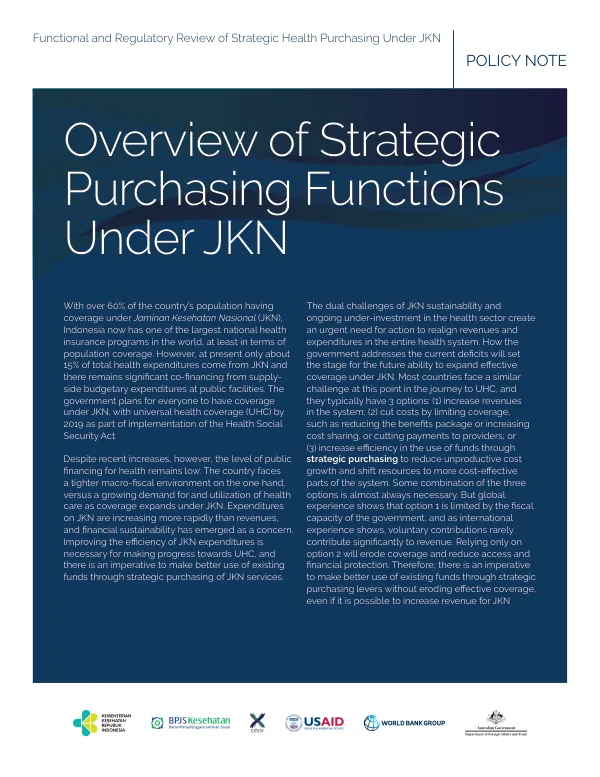
Strategic Purchasing Functions Under JKN
The dual challenges of JKN sustainability and ongoing under-investment in the health sector create an urgent need for action to realign revenues and expenditures in the entire health system.
2018 · 26 pages
Sign in to readA free account is required to download.
Abstract
The government's ability to expand effective coverage under JKN will be set by how it addresses the current deficits. Most countries face a similar challenge at this stage in the journey to universal health coverage, and they typically have three options: increase revenues in the system, reduce costs by limiting coverage, or improve efficiency in the use of funds through strategic purchasing. Strategic health purchasing involves strategically deciding what to buy, from whom to buy, and how to buy. This includes specifying quality standards, specifying quality standards, and setting payment rates. The institutional home for the purchasing function is Badan Penyenggara Jaminan Sosial-Kesehatan (BPJS-K), but some purchasing functions continue to be carried out within the Ministry of Health (MOH). Effective strategic purchasing requires distributing purchasing functions appropriately across institutions and having clear roles and responsibilities. The review examined existing laws and regulations related to JKN implementation to identify which institutions are responsible for carrying out which purchasing functions. The review found that the institutional structure for strategic health purchasing under JKN is still transitioning and urgently needs to be clarified. The review also identified some lessons from global experience on best practices for institutional arrangements to enable strategic purchasing. The review grouped 17 purchasing functions into categories and color-coded them to facilitate analysis of how they are distributed across institutions. The results showed that the purchasing functions are distributed across multiple institutions, with some functions being carried out by multiple institutions. The review also identified some areas where the institutional structure for strategic health purchasing under JKN needs to be clarified. The government plans for everyone to have coverage under JKN, with universal health coverage by 2019 as part of implementation of the Health Social Security Act. However, the level of public financing for health remains low, and expenditures on JKN expenditures are increasing more rapidly than the revenue. Improving the efficiency of JKN expenditures is necessary to make progress towards universal health coverage. The review identified some areas where the institutional structure for strategic health purchasing under JKN needs to be clarified. The review also identified some lessons from global experience on best practices for institutional arrangements to enable strategic purchasing. The review found that a coherent institutional structure is needed with clear roles and responsibilities, and that some functions should be separated and carried out by different institutions. The review also identified some areas where the purchasing functions are distributed across multiple institutions, with some functions being carried out by multiple institutions. The review found that the institutional structure for strategic health purchasing under JKN is still transitioning and urgently needs to be clarified. The review also identified some areas where the purchasing functions are not being carried out effectively. The review identified some areas where the institutional structure for strategic health purchasing under JKN needs to be clarified. The review also identified some lessons from global experience on best practices for institutional arrangements to enable strategic purchasing. The review found that a coherent institutional structure is needed with clear roles