USAID DEC
Strategic partnering to improve community health worker programming and performance: features of a community-health system integrated approach
Sign inUSAID
Strategic partnering to improve community health worker programming and performance: features of a community-health system integrated approach
Community health worker (CHW) programmes in low- and middle-income (LMIC) countries have the potential to extend the reach of inadequately resourced health systems to vulnerable and under-served populations.
2015 · 13 pages
Sign in to readA free account is required to download.
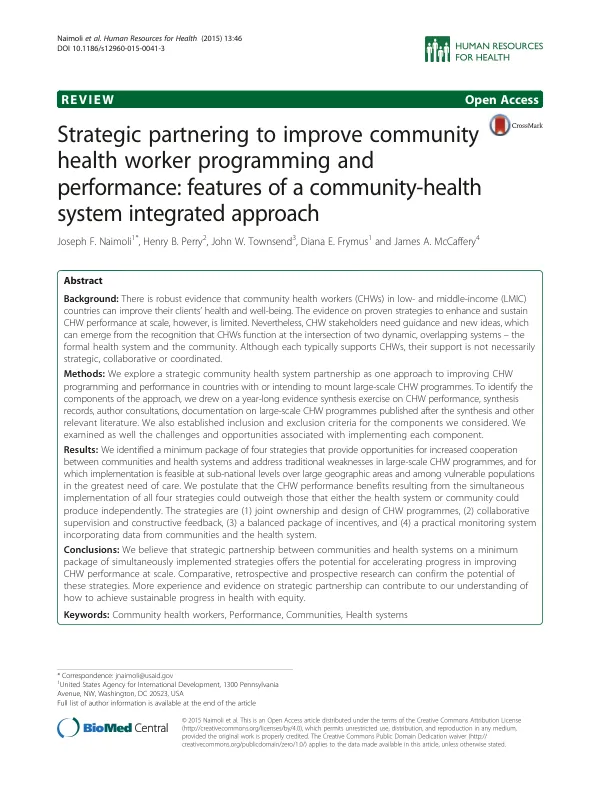
Abstract
Large-scale, national CHW programmes have been proposed as a key strategy to achieve universal health coverage in LMICs by 2030. CHWs, a heterogeneous cadre of frontline health workers, have been shown to improve people's health and well-being in diverse settings. CHW programmes, however, face numerous challenges, including weak political endorsement, problematic financing, fragmented oversight and technical support, and a lack of research on proven strategies to enhance and sustain CHW performance. Despite these challenges, there is a need for guidance and practical ideas on how to support and retain CHWs in large-scale programmes. A strategic partnership between communities and health systems offers a potential solution to these challenges. A strategic partnership between communities and health systems can provide opportunities for increased cooperation and address traditional weaknesses in large-scale CHW programmes. Four key strategies have been identified as essential components of this approach: joint ownership and design of CHW programmes, collaborative supervision and constructive feedback, a balanced package of incentives, and a practical monitoring system incorporating data from communities and the health system. These strategies can help to strengthen CHW programming and enhance CHW performance by combining the support efforts of health systems and communities in a purposeful way. By revisiting traditional approaches to improving performance and identifying and testing innovative solutions, health systems and communities can provide better value to CHWs. A more strategic alliance between communities and health systems can also help to maximize the efficient use of available resources and create synergies that can lead to positive spillovers in other areas of public health. Successful partnerships between communities and health systems require a serious commitment to good governance, a demonstrated willingness to work in tandem toward a common objective, and flexibility. Each party must contribute the requisite time, attention, skills, and resources necessary to ensure success. The best ways of working together must be tailored to the diverse needs and characteristics of communities and health systems. Examples of successfully functioning CHW programmes that report the presence of combined support from the community and the formal health system are documented in the literature. However, the extent to which this combined support was intentionally pre-designed is not well-documented. Further research is needed to inform and promote further reflection and discussion among policy makers, managers of health and community-based programmes, practitioners, and other CHW stakeholders. The simultaneous implementation of the four strategies identified in this paper, combined with research on the effectiveness of this integrated approach, could contribute to large-scale, national CHW programmes reaching their full potential. This, in turn, could promote accelerated progress toward achieving global health and development goals and universal health coverage with equity.