USAID DEC
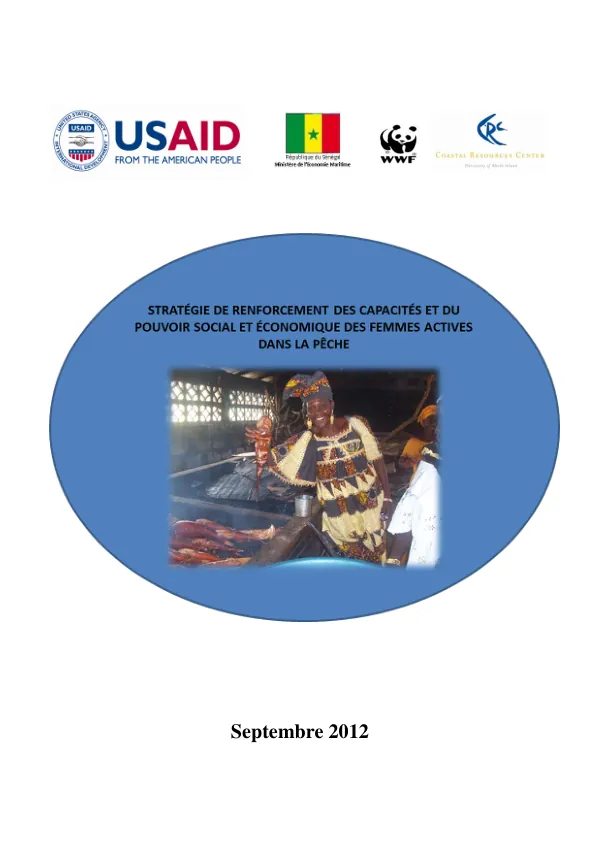
Stratégie de renforcement des capacités et du pouvoir social et économique des femmes actives dans la pêche
Sign inCOASTAL RESOURCES CENTER
Stratégie de renforcement des capacités et du pouvoir social et économique des femmes actives dans la pêche
The USAID/COMFISH project is a five-year initiative focused on collaborative management for a sustainable fisheries future in Senegal.
2012 · 37 pages
Sign in to readA free account is required to download.
Abstract
The project is funded by the United States Agency for International Development (USAID) and implemented by the University of Rhode Island (URI) in collaboration with the Government of Senegal and local partners. The project aims to address the challenges faced by women in the fisheries sector, who are marginalized in decision-making and governance processes. Women represent 52% of the population in Senegal and play a crucial role in the country's socio-economic development, particularly in the fisheries sector. However, they are relegated to low-value jobs and are the first to be affected by the sector's decline. The fisheries sector in Senegal is facing a crisis due to the depletion of resources and competition on export markets. Women are disproportionately affected by this crisis, and their roles and contributions in the sector are not recognized. The transformation industry, which was once dominated by women, is now increasingly dominated by men, with women being relegated to low-value jobs. The USAID/COMFISH project aims to address these challenges through a gender-based approach, which recognizes the importance of women's participation in decision-making and governance processes. The project's strategy focuses on three key areas: equitable representation of women, empowerment of women, and consideration of women's interests. The project's methodology involves capacity-building for different stakeholders, a participatory approach, and integration of actions to reinforce capacities. The project also aims to promote autonomy for women and adopt a gender-based approach. Partnerships with local organizations and women's groups are also essential to the project's success. The project's operational framework includes a strategic framework, a chronogram of activities, a budget, and a system for monitoring and evaluation. The project also includes a plan for follow-up and reporting, as well as an evaluation and audit component. The expected outcomes of the project include increased recognition of women's roles and contributions in the fisheries sector, improved information and training for women, and enhanced organization and participation of women in governance processes. The project also aims to strengthen women's capacities to manage income-generating activities, identify opportunities for income-generating activities, and implement sustainable resource management practices. The project's results are expected to be achieved through a combination of capacity-building, training, and support for women's organizations and groups. The project also aims to promote policy changes that favor women's participation and empowerment in the fisheries sector. The project's implementation is expected to have a positive impact on the lives of women in Senegal, particularly in the fisheries sector. By promoting women's participation and empowerment, the project aims to contribute to the sustainable development of the fisheries sector and the overall socio-economic development of the country.