COASTAL RESOURCES CENTER
Final Report: USAID/COMFISH Project, Senegal
The project USAID/COMFISH is a five-year initiative aimed at promoting sustainable fishing practices in Senegal.
2012 · 12 pages
Sign in to readA free account is required to download.
Abstract
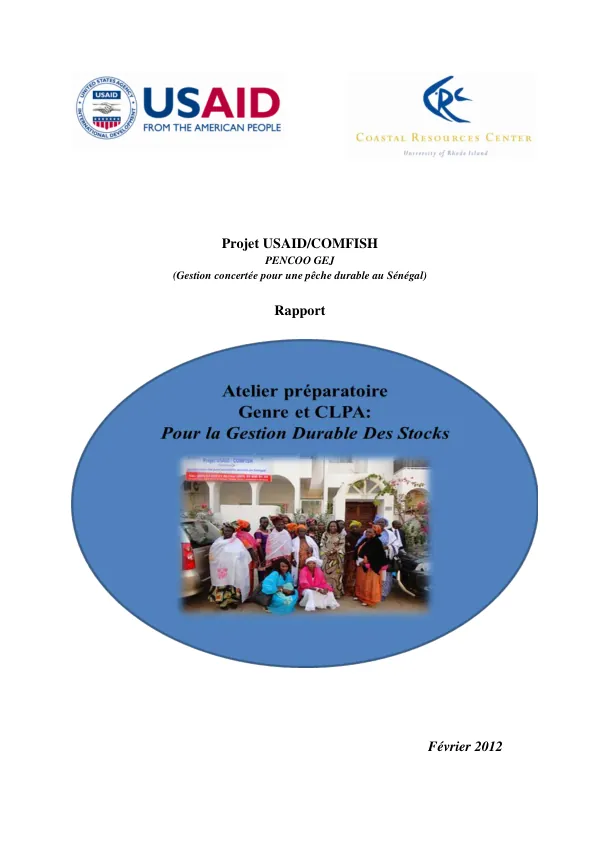
It is funded by the United States Agency for International Development (USAID) and implemented by the University of Rhode Island (URI) in collaboration with the Government of Senegal and various local partners. The project's focus on gender integration is a key aspect of its approach, with the goal of ensuring economic benefits for both men and women and enabling them to participate in decision-making processes. An evaluation study on the role of women in the artisanal fishing sector was conducted prior to an atelier on developing a gender strategy for stock management. This led to a meeting with women members of the various Coastal Resources Management Committees (CLPA) involved in the project. The meeting, held on February 23, brought together women from seven CLPA zones of intervention. The objectives of the meeting were to sensitize participants on the importance of gender in CLPA functioning, gather their views for better consideration of gender in CLPA, propose elements for reflection on better gender contribution in CLPA functioning, and draft a declaration taking into account women's interests, concerns, and values in all stock management plans implemented in Senegal. To facilitate the meeting, adapted pedagogical tools were used, including the use of Wolof as the language of communication, visual aids (drawings), traditional tools for message transmission (shells), and interactive dialogue. The meeting aimed to address the place of women in the current configuration of CLPA, discuss problems, concerns, and needs for better representation and contribution to stock management. The meeting's methodology involved the use of visual aids to explain complex concepts, such as the structure and functioning of CLPA. The presentation of CLPA was illustrated through a diagram, which showed the different components of CLPA, including the various colleges (administration, local elected officials, sages, fishermen, processors, and services) and the ICC. The presentation highlighted the importance of professionalization in the fishing sector, which would lead to better organization and functioning of CLPA. The process of decision-making was also discussed, with the women expressing the need to establish professional cards in the fishing sector to better control access to the profession and organize their activities. This would enable women to have representatives who could defend their interests efficiently and effectively. The meeting also addressed the issue of representation of men and women in CLPA, with the presentation highlighting the reasons for the current configuration of CLPA. The presentation showed that the limited number of women in the fishing sector made it difficult for them to have a significant presence in CLPA. The discussions during the meeting highlighted the points related to the under-representation of women in CLPA, including the absence of women in other sectors, lack of organization among women, and the penetration of men into the sector of women's intervention. The meeting aimed to address these issues and develop a strategy for improving the representation and contribution of women in CLPA. The draft declaration, which was the outcome of the meeting, aimed to take into account the interests, concerns, and values of women in all stock management plans implemented in Senegal.