USAID DEC
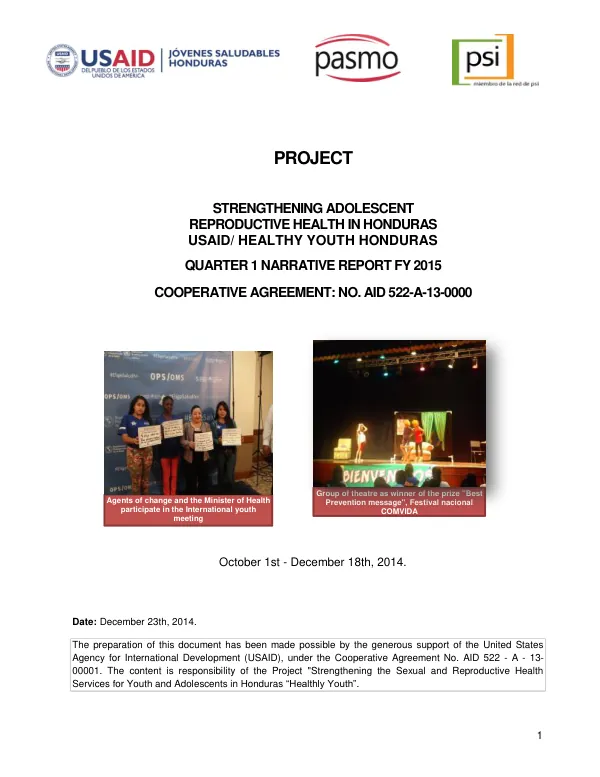
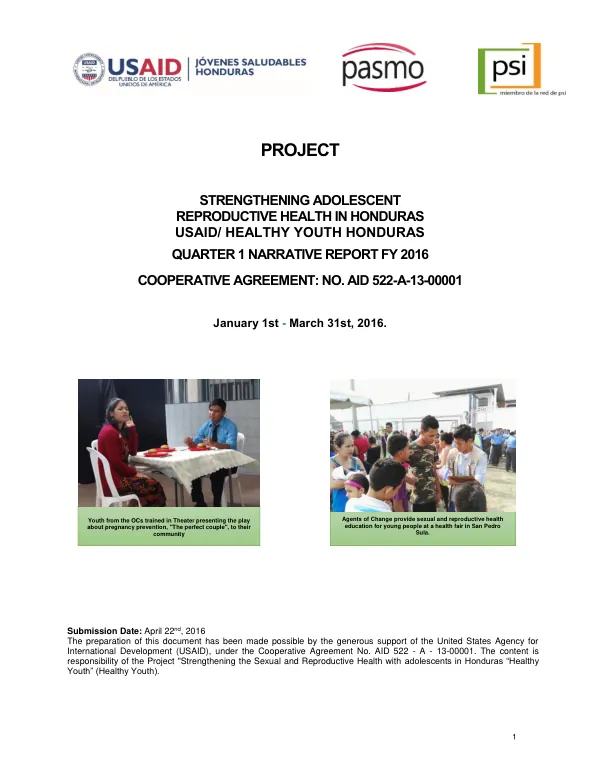
Strengthening Adolescent Reproductive Health in Honduras: USAID/Healthy Youth Honduras Quarterly Narrative Report FY 2016
Sign inPOPULATION SERVICES INTERNATIONAL/DKT INTERNATIONAL
Strengthening Adolescent Reproductive Health in Honduras: USAID/Healthy Youth Honduras Quarterly Narrative Report FY 2016
The Healthy Youth Project in Honduras aims to strengthen adolescent sexual and reproductive health (ASRH) among young people.
2016 · 51 pages
Sign in to readA free account is required to download.
Abstract
The project is technically and financially supported by the United States Agency for International Development (USAID) through the Central America Regional Security Initiative (CARSI). The project's objectives include improving access to health education, sexual and reproductive health services, and modern methods of contraception for young people in Honduras. Honduras faces significant challenges, including poverty, citizen insecurity, and high rates of crime, violence, and corruption. These factors contribute to rising crime among young people, jeopardizing the country's future. Over 50% of Honduras' population is under the age of 19, and many young people face challenges in accessing health education, sexual and reproductive health services, and modern methods of contraception. According to UNFPA, Honduras has a teen pregnancy rate of 24%, the second highest in Central America. Only 14.1% of women between the ages of 15-19 use modern contraceptive methods. Access to contraceptive services for young people and unmarried women is hindered by a lack of information on SRH and too few health centers that provide youth-friendly services. The project's activities include in-school and out-of-school interventions, teacher training, condom distribution, and social mobilization. In the first quarter of 2016, 1,723 adolescents and young people were exposed to messages about SRH, and 375 teachers were trained on strengthening sexual and reproductive health education. Additionally, 146,642 units of condoms were sold in the municipalities where the project is being implemented. The project also focuses on addressing the underlying factors contributing to adolescent pregnancy, including low levels of educational attainment, limited economic opportunities, and lack of access to SRH services. Harmful gender norms are a pervasive underlying cause of unintended adolescent pregnancy, transmission of STI, and GBV. The project aims to address these issues through a comprehensive approach that includes education, social mobilization, and access to SRH services. The project's progress is monitored and evaluated through a performance framework that tracks results continuously. The project also engages with other partners, including the Ministry of Education and the Ministry of Health, to ensure coordination and collaboration. The project's financial report for the first quarter of 2016 shows that the project has made significant progress in achieving its objectives. The project's lessons learned highlight the importance of addressing the underlying factors contributing to adolescent pregnancy and the need for a comprehensive approach that includes education, social mobilization, and access to SRH services. The project's success is also attributed to the strong partnerships with local organizations and the government, which have enabled the project to reach a large number of young people and provide them with the necessary information and services to make informed decisions about their health and well-being. The project's geographic focus is on Honduras, with a specific emphasis on the municipalities where the project is being implemented. The project's timeframes are from October 13, 2015, to April 13, 2017, with a quarterly reporting cycle. The project's recommendations include the need for continued support and funding to ensure the project's sustainability and scalability. The project's implementation details include the establishment of outreach centers, the training of teachers and community leaders, and the distribution of condoms and other SRH materials. The project also engages with local organizations and government agencies to ensure coordination and collaboration. The project's monitoring and evaluation framework includes the tracking of results continuously, the collection of data on project outcomes, and the analysis of lessons learned. The project's financial report for the first quarter of 2016 shows that the project has made significant progress in achieving its objectives. The project's challenges include the need for continued support and funding, the need to address the underlying factors contributing to adolescent pregnancy, and the need to ensure the project's sustainability and scalability. The project's proposed solutions include the need for continued partnerships with local organizations and government agencies, the need to engage with other stakeholders, and the need to ensure the project's financial sustainability. The project's gender component focuses on addressing the underlying factors contributing to adolescent pregnancy, including low levels of educational attainment, limited economic opportunities, and lack of access to SRH services. The project aims to address these issues through a comprehensive approach that includes education, social mobilization, and access to SRH services. The project's financial report for the first quarter of 2016 shows that the project has made significant progress in achieving its objectives. The project's lessons learned highlight the importance of addressing the underlying factors contributing to adolescent pregnancy and the need for a comprehensive approach that includes education, social mobilization, and access to SRH services. The project's coordination with other partners includes the Ministry of Education and the Ministry of Health, which have enabled the project to reach a large number of young people and provide them with the necessary information and services to make informed decisions about their health and well-being. The project's annexes include a list of key personnel involved in the project, a list of acronyms used in the report, and a list of references cited in the
Related documents