FHI 360
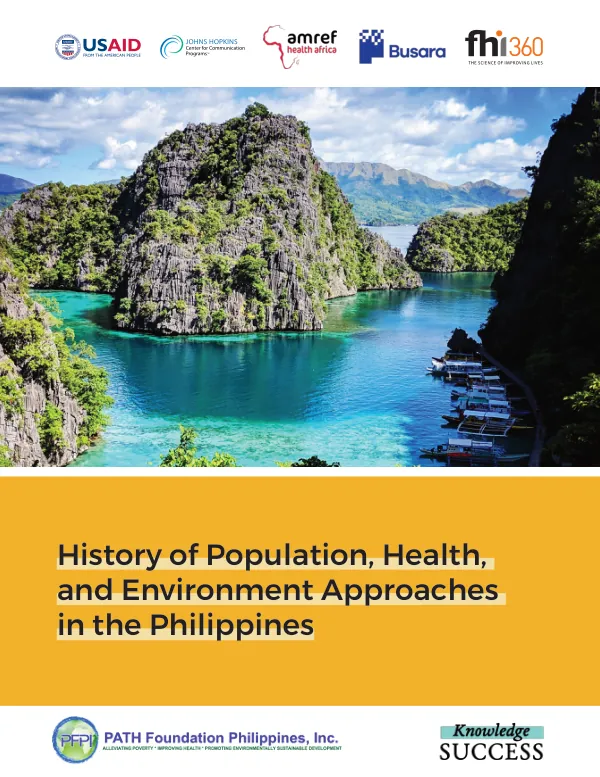
History of Population, Health, and Environment Approaches in the Philippines
The population, health, and environment (PHE) integrated approach in the Philippines began to take shape in the 1980s.
2021 · 41 pages
Sign in to readA free account is required to download.
Abstract
This approach aimed to address the interconnected challenges of high fertility, environmental degradation, and poverty by simultaneously addressing these factors under one set of interventions. The PHE approach was initially met with skepticism, but it eventually gained acceptance as a viable solution to the country's complex development challenges. One of the early trailblazing programs grounded in the PHE approach was the Integrated Population and Coastal Resource Management (IPOPCORM) initiative, launched in the late 1990s. This program brought together public health experts, conservationists, and economists to develop a multisectoral approach to addressing the complex challenges facing coastal communities. The IPOPCORM initiative was a key milestone in the development of the PHE approach in the Philippines, demonstrating the potential of integrated programming to achieve better health and environmental outcomes. The PHE approach gained momentum in the early 2000s, with the launch of several new programs and initiatives. These programs focused on scaling up PHE interventions in various parts of the country, including rural and marginalized communities. The PHE approach was also recognized as a key strategy for addressing the country's rapid population growth, which was placing a strain on the country's natural resources and infrastructure. In 2006, the PHE approach was further strengthened with the launch of the Policy, Advocacy, and Communication Enhanced for Population and Reproductive Health Project (PACE). This project aimed to promote the PHE approach at the national and local levels, and to build the capacity of government agencies, civil society organizations, and other stakeholders to implement PHE programs. The PHE approach continued to evolve and expand in the following years, with a focus on reaching marginalized communities and addressing the specific needs of vulnerable populations. The approach was also recognized as a key strategy for addressing the country's environmental challenges, including deforestation, land degradation, and climate change. Today, the PHE approach is widely recognized as a critical component of the country's development strategy. The approach has been implemented in various parts of the country, and has achieved significant results in terms of improved health and environmental outcomes. The PHE approach has also been recognized as a model for other countries to follow, and has contributed to the global recognition of the importance of integrated programming in addressing complex development challenges. The Philippines' experience with the PHE approach has also highlighted the importance of local ownership and participation in the implementation of PHE programs. The approach has been successful in engaging local communities and stakeholders in the planning and implementation of PHE programs, and has helped to build the capacity of local governments and civil society organizations to address the complex challenges facing their communities. In conclusion, the PHE approach in the Philippines has come a long way since its inception in the 1980s. From its early beginnings as a trailblazing program to its current status as a widely recognized and implemented approach, the PHE approach has demonstrated its potential to achieve better health and environmental outcomes in the country. The approach continues to evolve and expand, with a focus on reaching marginalized communities and addressing the specific needs of vulnerable populations.
Related documents