USAID DEC
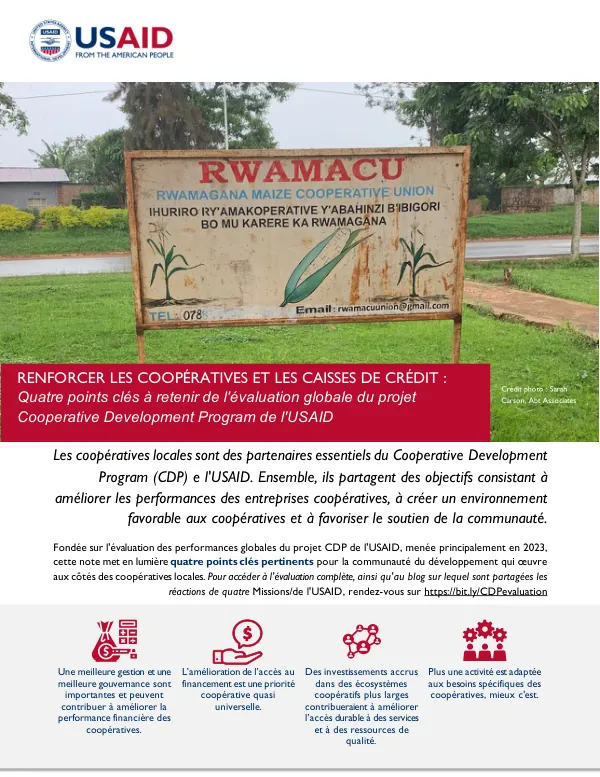
STRENGTHENING COOPERATIVES AND CREDIT UNIONS: Four Key Takeaways from the Whole-of-Project Evaluation of USAID's Cooperative Development Program
Sign inABT ASSOCIATES
STRENGTHENING COOPERATIVES AND CREDIT UNIONS: Four Key Takeaways from the Whole-of-Project Evaluation of USAID's Cooperative Development Program
The Cooperative Development Program (CDP) is a global initiative that supports local cooperatives as trusted local democratic institutions.
2023 · 4 pages
Sign in to readA free account is required to download.
Abstract
CDP primarily works with producer cooperatives, but also supports financial, health, consumer, worker, and housing cooperatives. From 2018 to 2023, nine cooperative development organizations partnered with CDP, supporting hundreds of cooperatives in 17 countries. Improved management and governance are key to cooperatives' successful functioning. CDP's contribution to advancements in these areas has led to better cooperative business performance. Three related types of management and governance improvements stood out: increased transparency, better recordkeeping, and better understanding of roles and responsibilities both for leaders and for members. Enhanced recordkeeping, in particular, had important benefits, as cooperatives noted that it led to better access to finance because it gave financial institutions more ability to assess their creditworthiness. Improved access to finance is a nearly universal cooperative priority. In the CDP project, cooperatives often experienced improved access to finance when implementing partners specifically emphasized this as a goal. However, some cooperatives still face major challenges in accessing finance, often due to a lackluster reputation among financial institutions. Increased investment in wider cooperative ecosystems could help to improve sustained access to quality services and resources. The more tailored an activity is to cooperatives' specific needs, the better. Implementing partners' adaptability in tailoring their activities to cooperatives' needs was a key factor for success. Models to achieve this customization varied, but responsiveness to cooperatives' demand and context was crucial. In some cases, when implementing partners used structured training curricula or standardized tools, cooperatives reported confusion or challenges because they did not see the relevance of the activities to their needs. The evaluation team used a combination of qualitative and quantitative data, including project documentation, monitoring data, key informant interviews, focus group discussions, and a phone survey of cooperative leaders. The evaluation team combined, triangulated, and synthesized the data to assess CDP's contribution to its overall project purpose and intermediate results using a contribution analysis approach. The evaluation findings are relevant for organizations working with local cooperatives, highlighting the importance of management and governance improvements, improved access to finance, and tailored activities that meet cooperatives' specific needs.
Related documents