CHEMONICS
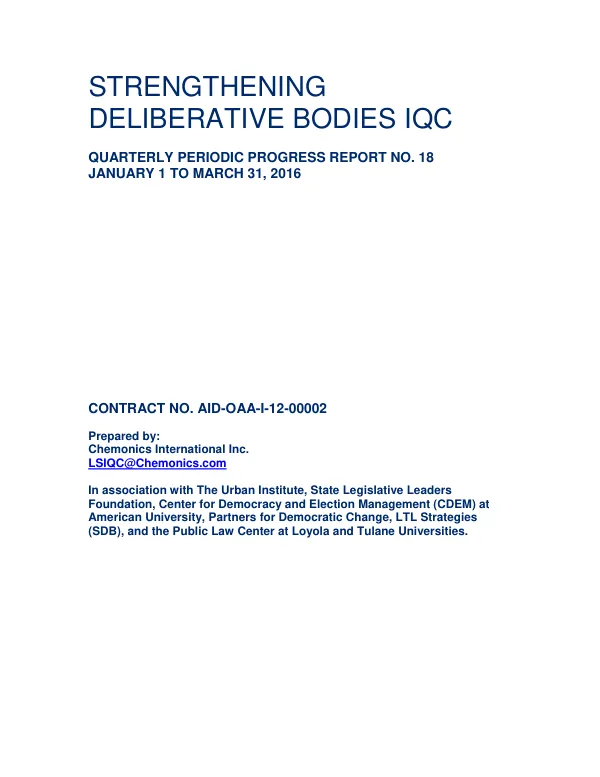
Strengthening Deliberative Bodies IQC: Quarterly Report Number 18
The Strengthening Deliberative Bodies IQC is a quarterly periodic progress report covering the period from January 1 to March 31, 2016.
2016 · 4 pages
Sign in to readA free account is required to download.
Abstract
The report is prepared by Chemonics International Inc. in association with several partners, including The Urban Institute, State Legislative Leaders Foundation, and Center for Democracy and Election Management. The primary objective of the IQC is to build the capability of USAID to strengthen legislative bodies at the local, sub-national, and national levels of government. The consortium aims to assist legislative bodies in becoming more effective, democratic institutions through programs and activities that encourage accountability, transparency, and pluralism. During the reporting period, Chemonics staff completed the "Strengthening Deliberative Bodies Reference Paper" and presented the findings at the Legislative Strengthening Conference conducted by the Center of Excellence on Democracy, Human Rights and Governance. The paper presents eight case studies addressing topics such as cross-sectoral strengthening programs, accountability and transparency, and implementation and evaluation. The Technical Leadership in Legislative Strengthening (TLTS) task order, awarded in August 2015, aims to produce research and analysis on selected themes of interest in the field of legislative strengthening. The primary audiences for these papers will be USAID staff in Washington and field missions who design and manage governance programs. Deliverables under this task order include an outline of proposed approach and topics, a reference paper, data entry, and a workshop. The PMU is currently compiling a list of all Chemonics-implemented USAID-funded projects on legislative strengthening since 1995. Chemonics is awaiting further guidance from USAID regarding the content, format, manner, and timeline of the data entry deliverable. The consortium continues to address individual and collective concerns of its members, and no major issues arose during the reporting period. Monitoring and evaluation results are not reported for this quarter. No management and administrative issues, new programmatic trends, or outstanding constraint issues are also reported.