DAI GLOBAL, LLC
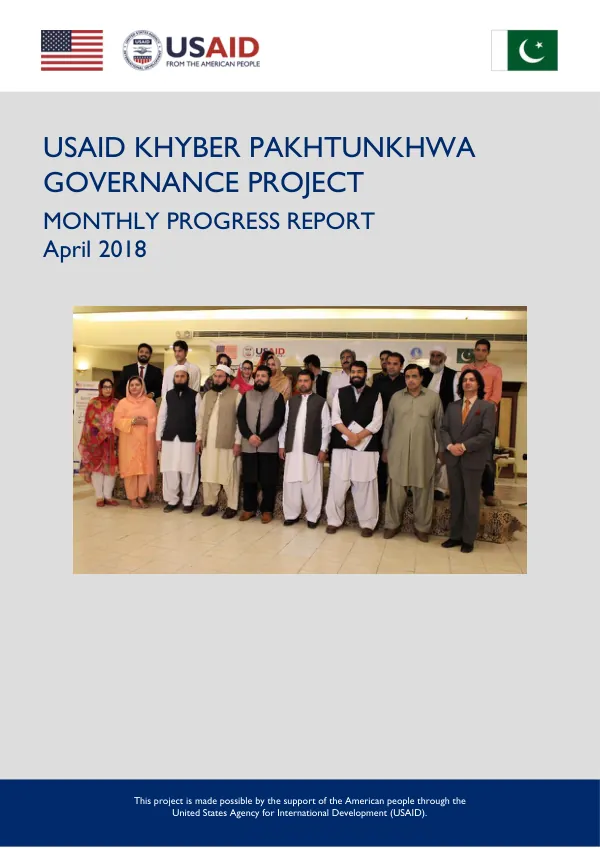
Khyber Pakhtunkhwa Governance Project Monthly Progress Report April 2018
The Khyber Pakhtunkhwa Governance Project (KPG) is a four-year initiative aimed at supporting transitional activities that reinforce and promote democratic advances in the province.
2018 · 18 pages
Sign in to readA free account is required to download.
Abstract
The project was awarded to DAI Global LLC in March 2015, with a budget of $22.6 million. The project's primary objective is to improve service delivery by public institutions and strengthen transparency and accountability of public service providers. KPG activities are closely aligned with the Khyber Pakhtunkhwa Government's Integrated Development Strategy (IDS), which integrates government priorities under one framework and provides a roadmap for achieving targets agreed to in the Strategic Development Partnership Framework (SDPF). The project will focus on supporting the achievement of relevant priority objectives through four main instruments: Grants Under Contract (GUC), Programmatic Short-Term Technical Assistance (STTA), Direct Distribution of Goods and Services (DDGS), and Training. During the month of April 2018, KPG made significant progress towards achieving its targets. In terms of output, the project achieved 1 out of 10 laws promoting decentralization, 2 out of 20 processes improved, and 3 out of 10 facilities renovated or constructed with USG assistance. Additionally, 344 government officials with increased targeted competencies were identified, and 5,398 elected representatives received training with USG assistance. In terms of indicators, KPG made progress in strengthening the Provincial Housing Authority (PHA). The project implemented a program to improve the PHA's capacity to deliver essential services, which resulted in the renovation or construction of 3 facilities. Furthermore, 6 processes were improved, and 2 policies were supported. The project also made progress in engaging civil society organizations (CSOs) in advocacy interventions. A total of 6 CSOs received USG assistance and engaged in advocacy interventions, and 6 USG-assisted campaigns and programs were implemented to enhance public understanding of government policies and service delivery mechanisms. In terms of youth engagement, the project reported that 23,905 youth were engaged in recreational, cultural, or other benign activities through USG assistance.
Related documents