USAID DEC
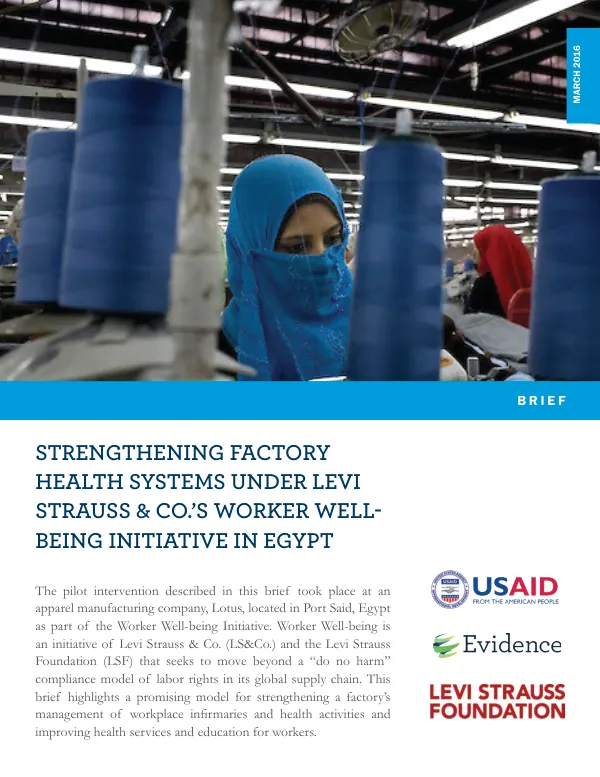
Strengthening Factory Health Systems Under Levi Strauss & Co.'s Worker Well-being Initiative in Egypt
Sign inLEVI STRAUSS FOUNDATION
Strengthening Factory Health Systems Under Levi Strauss & Co.'s Worker Well-being Initiative in Egypt
The Worker Well-being Initiative in Egypt, a pilot intervention led by Levi Strauss & Co.
2016 · 8 pages
Sign in to readA free account is required to download.
Abstract
(LS&Co.) and the Levi Strauss Foundation (LSF), aimed to strengthen factory health systems and improve health services and education for workers. The initiative focused on the apparel manufacturing company Lotus, located in Port Said, Egypt, which employed over 6,500 workers, with more than half being women. The factory had six clinical sites in each production hall staffed by six nurses, but the nurses were underutilized and provided mainly curative healthcare services. The Evidence Project/RAISE Health provided technical assistance to strengthen the factory's health functions by expanding the role of nurses, developing clinical quality standards and practices, and integrating management systems and oversight of health functions. The HERproject, a 12-month health education and awareness-raising program, was implemented by Business for Social Responsibility (BSR) and the Egyptian Family Planning Association (EFPA) to improve the health knowledge and behaviors of women and men workers, as well as workplace nurses. The program included reproductive health, family planning, nutrition, general and menstrual hygiene, and sexually transmitted diseases. The Evidence Project/RAISE Health's technical assistance included providing tools and guidance for assessing clinics' services and infirmaries, supporting the analysis of the assessment and development of a management action plan, identifying systems that could support healthcare delivery, and providing management training materials and lessons learned from other factories. The intervention targeted factory workers, management, and nurses, with the nurses providing health education on various topics, including family planning and reproductive health. EFPA trained 88 men and 108 women workers as peer educators to speak to their coworkers on health topics. The Evidence Project/RAISE Health strengthened factory health systems and practices by addressing three interrelated components: expanding the role of nurses, developing clinical quality standards and practices, and integrating management systems and oversight of health functions. The factory's management agreed to allow a more active role for the nurses, who were trained as Master Trainers on health and assumed formal responsibility for overseeing the weekly activities of peer health educators, managing the overall factory health education program, and providing private health education or counseling sessions to workers. The initiative aimed to improve services and health outreach to men and women workers, particularly in reproductive health and family planning, and to strengthen the factory's capacity and systems to sustain new clinical practices and health education activities. The Worker Well-being Initiative in Egypt demonstrated a promising model for strengthening factory health systems and improving health services and education for workers. The initiative's focus on expanding the role of nurses, developing clinical quality standards and practices, and integrating management systems and oversight of health functions addressed common weaknesses of infirmaries and health services at workplaces globally. The initiative's success in improving services and health outreach to men and women workers, particularly in reproductive health and family planning, highlights the importance of prioritizing worker health and well-being in the global supply chain.