USAID DEC
Two implementation models of workers’ health education programs in Egypt: What works? What doesn’t work?
Sign inWORLD LEARNING
Two implementation models of workers’ health education programs in Egypt: What works? What doesn’t work?
The agricultural development initiative in Egypt began in 2017 and focused on increasing family planning (FP) service demand among young people aged 18-35 in Port Said and urban Souhag.
2020 · 4 pages
Sign in to readA free account is required to download.
Abstract
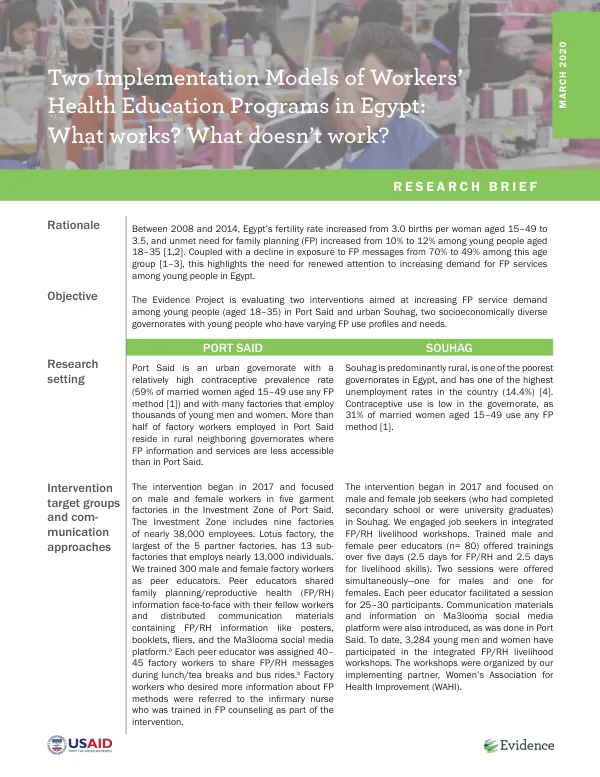
The initiative aimed to improve knowledge and attitudes about FP among this age group, who have a high unmet need for FP services. In Port Said, the intervention began in 2017 and targeted male and female workers in five garment factories in the Investment Zone. The intervention included training 300 male and female peer educators to share FP/RH information with their fellow workers and distribute communication materials. In Souhag, the intervention began in 2017 and targeted male and female job seekers who had completed secondary school or were university students. The intervention included integrated FP/RH workshops, which were organized by the Women's Association for Health Improvement (WAHI). The research found that in Port Said, there were few significant improvements in any of the key indicators, as shown in the results of a difference-in-differences (DiD) analysis comparing the intervention to the comparison group between baseline and endline. The data suggest that there was little impact of the intervention on workers' knowledge and attitudes. This may be a result of workers' busy schedules and the low peer educator to worker ratio, which resulted in limited exposure to the intervention. In contrast, the intervention in Souhag showed significant improvements in knowledge and attitudes about FP among young people. The phone interviews reached participants who had received the intervention, and the peer educator to participant ratio was high, resulting in repeated contact between peer educators and participants. The research also found that in Souhag, the intervention had a significant impact on young people's knowledge and attitudes about FP. The DiD analysis showed that participants who received the intervention were more likely to disagree with the statement that FP methods have a negative impact on health, to name optimal birth spacing interval as three or more years, to know modern FP methods, and to be willing to use FP in the future. The results suggest that the intervention in Souhag was more effective in improving knowledge and attitudes about FP among young people. The research highlights the need for renewed attention to increasing demand for FP services among young people in Egypt. The findings suggest that the intervention in Souhag was more effective in improving knowledge and attitudes about FP among young people, possibly due to the higher peer educator to participant ratio and repeated contact between peer educators and participants. The results also suggest that the intervention in Port Said had little impact on workers' knowledge and attitudes, possibly due to workers' busy schedules and limited exposure to the intervention.
Related documents