USAID DEC
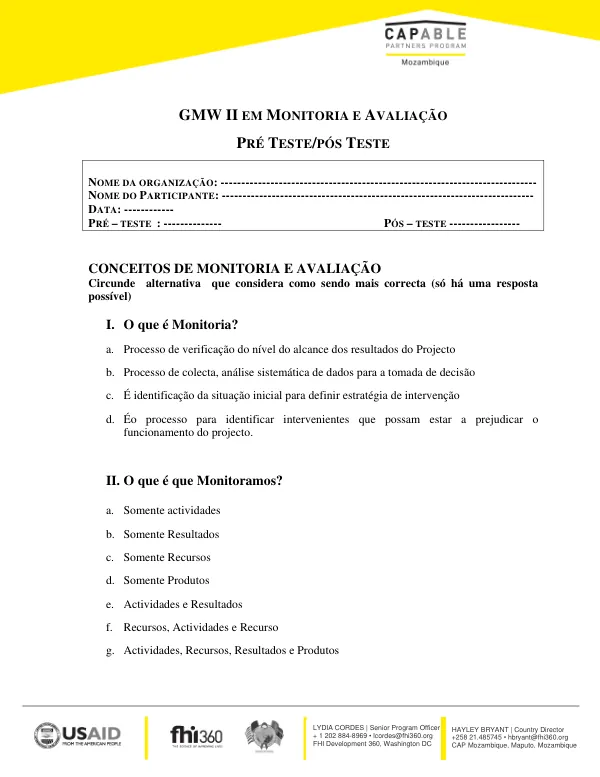
Strengthening Leading Mozambican NGOs and Networks II: Pre and Post Tests, Developing a Monitoring and Evaluation Plan
Sign inACADEMY FOR EDUCATIONAL DEVELOPMENT
Strengthening Leading Mozambican NGOs and Networks II: Pre and Post Tests, Developing a Monitoring and Evaluation Plan
Monitoring and evaluation are critical components of project implementation, enabling organizations to assess progress, identify areas for improvement, and make data-driven decisions.
2012 · 3 pages
Sign in to readA free account is required to download.
Abstract
The concept of monitoring involves the systematic collection, analysis, and use of data to inform decision-making and ensure that project objectives are met. Monitoring focuses on tracking activities, resources, and outcomes to determine the extent to which a project is achieving its intended goals. Monitoring can be conducted at various stages of project implementation, including the beginning, middle, and end. It is essential to establish clear monitoring indicators, which are measurable variables used to track progress and assess the effectiveness of project interventions. Indicators can be categorized into activities, resources, outcomes, and products. Activities refer to the tasks and processes undertaken to achieve project objectives, while resources encompass the inputs, such as personnel, equipment, and financial support, required to implement the project. Outcomes represent the changes or results achieved as a direct result of project interventions, and products refer to the tangible outputs produced by the project. Avaliação, or evaluation, is a process of collecting and analyzing information to determine the extent to which a project has achieved its objectives. Evaluation involves assessing the relevance, effectiveness, efficiency, impact, and sustainability of project interventions. It is essential to conduct evaluations at various stages of project implementation, including the beginning, middle, and end, to identify areas for improvement and make adjustments as needed. In the context of the Strengthening Leading Mozambican NGOs and Networks II project, monitoring and evaluation are critical components of project implementation. The project aims to strengthen the capacity of leading Mozambican NGOs and networks to implement effective HIV and AIDS programs. To achieve this objective, the project must establish clear monitoring and evaluation indicators, collect and analyze data, and use the information to inform decision-making and ensure that project objectives are met. The project's monitoring and evaluation plan should include the development of indicators, data collection tools, and analysis procedures. Indicators should be specific, measurable, achievable, relevant, and time-bound (SMART), and data collection tools should be designed to collect relevant and reliable data. The analysis of data should involve the use of statistical techniques and other methods to identify trends, patterns, and correlations. In addition to monitoring and evaluation, the project should also establish a system for reporting and disseminating information. This system should include regular reporting to stakeholders, including project partners, donors, and government officials, as well as the dissemination of information through various channels, such as reports, newsletters, and social media. The PEPFAR (President's Emergency Plan for AIDS Relief) program is a US government initiative aimed at providing emergency relief to countries affected by the HIV and AIDS epidemic. The program provides funding and technical assistance to countries to support the implementation of effective HIV and AIDS programs. PEPFAR is a critical component of the global response to the HIV and AIDS epidemic, and its funding and technical assistance have been instrumental in scaling up HIV and AIDS programs in many countries. In conclusion, monitoring and evaluation are critical components of project implementation, enabling organizations to assess progress, identify areas for improvement, and make data-driven decisions. The Strengthening Leading Mozambican NGOs and Networks II project must establish clear monitoring and evaluation indicators, collect and analyze data, and use the information to inform decision-making and ensure that project objectives are met. The project's monitoring and evaluation plan should include the development of indicators, data collection tools, and analysis procedures, as well as a system for reporting and disseminating information.