LANDESA
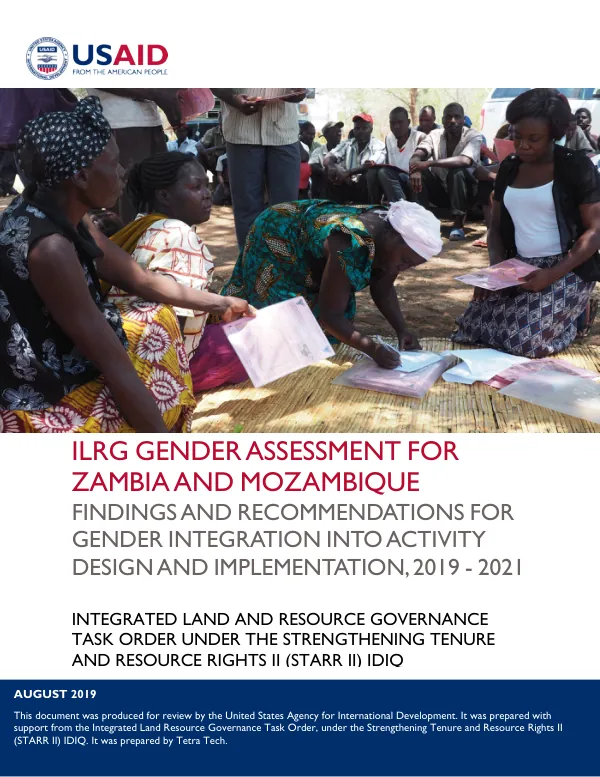
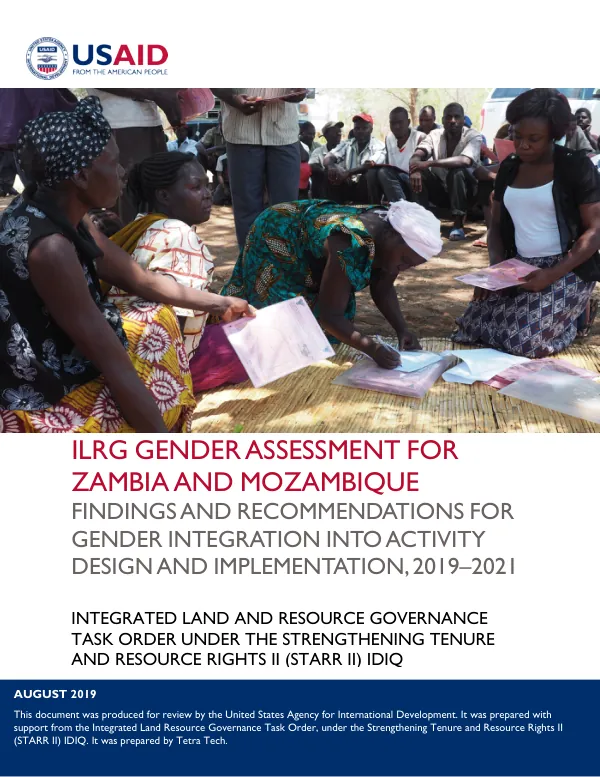
Integrated Land and Resource Governance Gender Assessment for Zambia and Mozambique
The Integrated Land and Resource Governance (ILRG) program's Gender Integration Strategy aims to apply its principles to project objectives and activities in Zambia and Mozambique.
2019 · 27 pages
Sign in to readA free account is required to download.
Abstract
The assessment focuses on four areas: documentation of customary/community land rights, administration of customary/community land rights, land use planning, and governance of forestry and wildlife resources. The primary source of data for the assessment relates to work previously done under the Tenure and Global Climate Change (TGCC) program in Zambia and the Responsible Investment Pilot in Mozambique. In Zambia, the assessment found that women's equal participation in land and resource governance is hindered by broader social and customary setting issues, such as limited access to land and resources, and direct project-related issues, including inadequate community engagement and customary rights registration. The assessment also identified issues related to customary land administration, land use planning, community management of forestry and wildlife, and legal and policy engagement. In Mozambique, the assessment found that women's equal participation in land and resource governance is hindered by broader social and customary setting issues, such as limited access to land and resources, and direct project-related issues, including inadequate gender integration in design and implementation. The assessment also identified issues related to follow-up research and understanding, gender integration in design and implementation, and legal and policy engagement. The assessment recommends that the ILRG program prioritize community engagement and customary rights registration in Zambia, and follow-up research and understanding in Mozambique. The assessment also recommends that the program integrate gender into design and implementation, and engage with governments, communities, civil society, and the private sector to ensure a robust integration of the gender strategy. The assessment team used a combination of data collection methods, including key informant interviews, focus group discussions, and review of existing literature and project documents. The assessment is forward-looking, intended to inform practical steps that can be taken by ILRG staff and implementation partners to ensure a robust integration of the gender strategy and to flag urgent and important issues for follow-up. The assessment highlights the importance of addressing gender-biased social norms that continue to keep women and other vulnerable groups from participating equally in land and resource governance. The assessment also emphasizes the need for the ILRG program to work with governments, communities, civil society, and the private sector to ensure a robust integration of the gender strategy and to address the identified issues and gaps in gender equality. The assessment is limited in scope by time, with only one week in each country, spread between the respective capital cities and three project sites. The assessment team did not attempt to do deep substantive research, but rather to gain enough knowledge as quickly as possible to identify and begin to explore risks and opportunities moving forward. The assessment is intended to be a starting point for further work and to inform practical steps that can be taken by ILRG staff and implementation partners to ensure a robust integration of the gender strategy. The assessment identifies several key areas for follow-up research and analysis, including legislative and policy issues, and issues for further data analysis. The assessment also highlights the need for the ILRG program to work with governments, communities, civil society, and the private sector to ensure a robust integration of the gender strategy and to address the identified issues and gaps in gender equality. The assessment is a critical component of the ILRG program's efforts to ensure a robust integration of the gender strategy and to address the identified issues and gaps in gender equality. The assessment provides a foundation for further work and informs practical steps that can be taken by ILRG staff and implementation partners to ensure a robust integration of the gender strategy and to flag urgent and important issues for follow-up.
Related documents