USAID DEC
The Role of the Private Sector in Reintegration: Lessons Learned from Colombia, Namibia, and Mozambique
Sign inINTERNATIONAL ORGANIZATION FOR MIGRATION
The Role of the Private Sector in Reintegration: Lessons Learned from Colombia, Namibia, and Mozambique
The Colombian case study on excombatant reintegration highlights the increasingly important role of the private sector in this process.
2018 · 2 pages
Sign in to readA free account is required to download.
Abstract
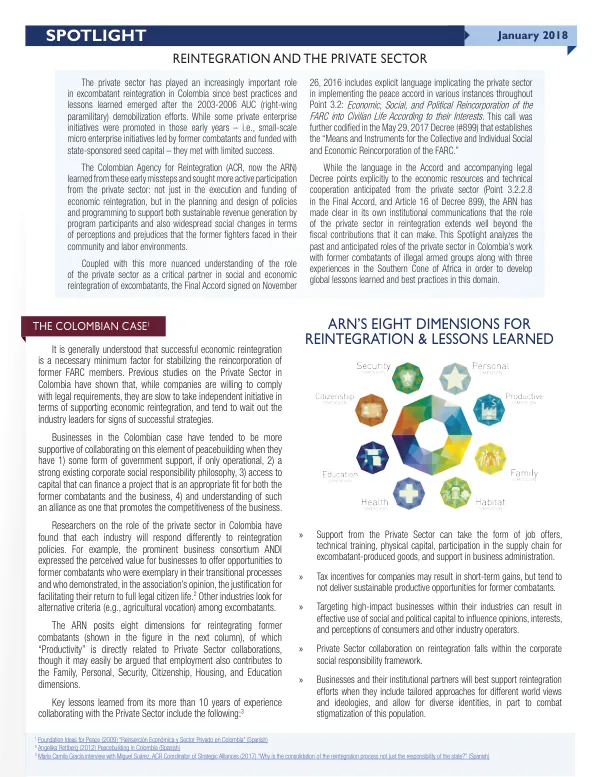
Since the 2003-2006 AUC demobilization efforts, best practices and lessons learned have emerged, leading to more active participation from the private sector in the planning and design of policies and programming to support economic reintegration. The Colombian Agency for Reintegration (ACR), now the ARN, has learned from early missteps and sought more nuanced understanding of the private sector's role in social and economic reintegration. The Final Accord signed on November 26, 2016, includes explicit language implicating the private sector in implementing the peace accord, particularly in Point 3.2: Economic, Social, and Political Reincorporation of the FARC into Civilian Life According to their Interests. The ARN has made clear that the role of the private sector in reintegration extends beyond fiscal contributions, encompassing job offers, technical training, physical capital, participation in the supply chain, and support in business administration. Research on the private sector's role in Colombia has shown that businesses tend to be more supportive of collaborating on economic reintegration when they have government support, a strong corporate social responsibility philosophy, access to capital, and an understanding of the alliance as one that promotes business competitiveness. Each industry responds differently to reintegration policies, with some industries looking for alternative criteria among excombatants. The ARN has identified eight dimensions for reintegrating former combatants, with "Productivity" directly related to private sector collaborations. Key lessons learned from the ARN's experience collaborating with the private sector include the importance of tailored approaches for different world views and ideologies, allowing for diverse identities to combat stigmatization of the population. In the Colombian case, the private sector's involvement in reintegration has been more successful when it has been actively engaged in the planning and design of policies and programming. This has led to more effective use of social and political capital to influence opinions, interests, and perceptions of consumers and other industry operators. The Spotlight also examines the experiences of Namibia, Mozambique, and South Africa in reintegration efforts. In Namibia, the Development Brigade was formed in 1991 to train and find work for demobilized fighters, but lack of private sector involvement resulted in inadequate basic skill development and a lack of alignment between the needs of Namibian industries and the capabilities of excombatants. In Mozambique, the initial reintegration program raised expectations far beyond what it was capable of delivering, leading to long-term challenges in the process. The inability of former combatants to acquire vocational skill sets of value to local labor markets resulted in high levels of recidivism among mid- and high-ranking demobilized individuals. In South Africa, the Employer Initiative Retrenchment (EIR) offered educational and vocational training to former combatants, but opportunities presented through the program were inadequate and underutilized. The reintegration effort placed former combatants without training or educational leveling processes directly in companies, resulting in complications such as low skill levels and verbal abuse from work supervisors. These experiences highlight the importance of considering the role of the private sector within the constellation of social, security, and political forces in which it operates at the territorial level. Involving local private sector leaders at the territorial level in the planning and development phases can lead to more effective reintegration efforts.