OPEN UNIVERSITY
Strengthening Local Capacity for the Surveillance of Anopheles stephensi in Nigeria
The invasive malaria-transmitting mosquito Anopheles stephensi poses a significant threat to Nigeria's malaria control efforts.
2023 · 3 pages
Sign in to readA free account is required to download.
Abstract
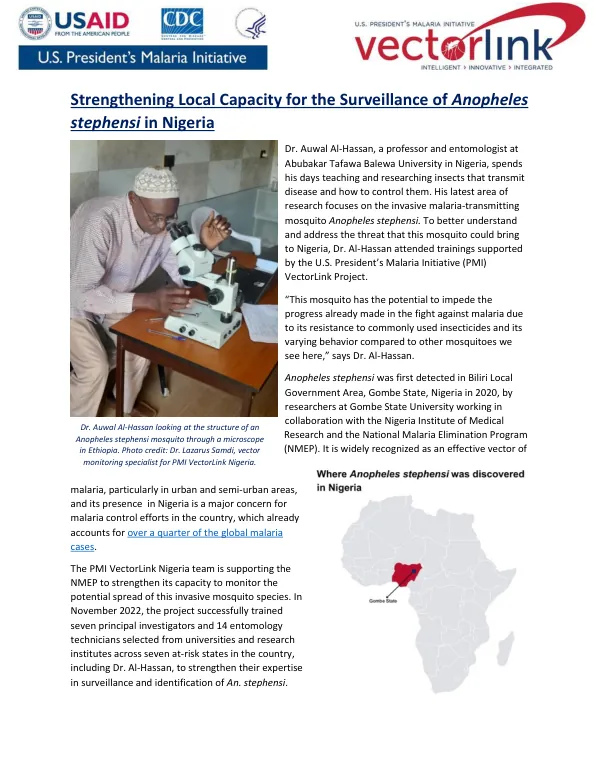
Initially detected in Biliri Local Government Area, Gombe State, in 2020, this mosquito species is recognized as an effective vector of malaria, particularly in urban and semi-urban areas. Its presence in Nigeria is a major concern, given that the country already accounts for over a quarter of the global malaria cases. The U.S. President's Malaria Initiative (PMI) VectorLink Project is supporting the National Malaria Elimination Program (NMEP) to strengthen its capacity to monitor the potential spread of Anopheles stephensi. In November 2022, the project successfully trained seven principal investigators and 14 entomology technicians from universities and research institutes across seven at-risk states in the country. The training covered the preferred habitats of An. stephensi, which is key to detecting and understanding how to control its spread. Adult Anopheles stephensi mosquitoes prefer urban environments, while larvae are commonly found to exploit several larval habitat types, including human-made water containers such as plastic tanks, cisterns, discarded tires, and plastic containers. The training also covered the use of the Prokopac aspirator to collect adult Anopheles stephensi mosquitoes. PMI VectorLink Ethiopia Technical Manager Dr. Meshesha Balkew participated virtually in the training and shared best practices with the participants on identifying the breeding and resting sites of this species as well as how to identify adult An. stephensi mosquitoes. Dr. Auwal Al-Hassan, a professor and entomologist at Abubakar Tafawa Balewa University in Nigeria, traveled to Ethiopia to learn more from Dr. Balkew and the PMI VectorLink Ethiopia team about their experience with An. stephensi. This training reinforced what he learned in Nigeria, but also delved into one of the main control strategies for An. stephensi: larval source management (LSM). LSM involves applying a chemical, called a larvicide, to water in containers in order to kill the mosquito in its immature stage. With a well-trained team now in place, the next step is to intensify surveillance and identification of Anopheles stephensi throughout the country. Data collected by researchers like Dr. Al-Hassan will be key to informing the approach used by Nigeria's NMEP to combat An. stephensi. The data will help the NMEP use resources optimally, prioritizing key activities in order to achieve effective and sustainable control of An. stephensi in Nigerian environments.
Related documents