DELOITTE INC.
Strengthening PFM in LAC Project: Dominican Republic
The Dominican Republic's tax revenue has increased by 1.6% of GDP from 2003 to 2012.
2014 · 12 pages
Sign in to readA free account is required to download.
Abstract
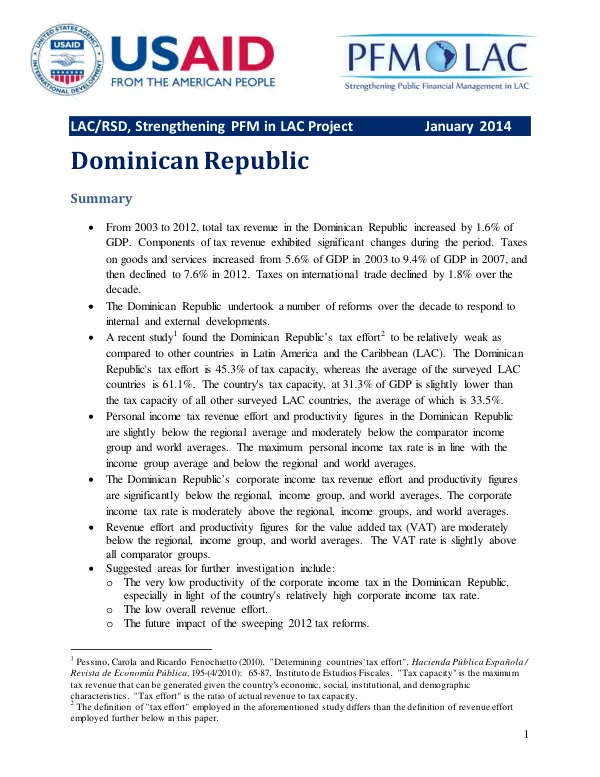
Revenues reached a peak of 16.0% of GDP in 2007, but declined after 2007 due to tax reforms, natural disasters, and the financial crisis. The revenue mix shifted toward an increased reliance on domestic sales taxes and decreased reliance on taxes on international trade. Revenue from taxes on income and profits increased by 0.7% of GDP over the decade, while revenue from taxes on goods and services increased by 2% of GDP. Revenue from taxes on international trade decreased by 1.8% of GDP. The 2005 Tax Reform Act gradually lowered the personal income tax and withholding rates from 30% to 25%, increased the general VAT rate from 12% to 16%, restricted the VAT zero-rate to exports, and added several new item-specific consumption taxes. The 2007 Law of Fiscal Reform lowered the corporate income tax rate from 29% to 25%. The law included measures to increase excise tax rates, such as those on alcohol, cigarettes, vehicles, and fuel. It also established more severe sanctions for violations of the tax law and increased the inspection powers of tax examiners. Tax reforms in 2011 raised the corporate income tax back up to 29% and established a 1% tax on performing financial assets of financial institutions. The 2012 tax reforms included changes to the VAT, personal income tax, and corporate income tax regimes. The country introduced a temporary VAT rate increase from 16% to 18% for 2013 and 2014, scheduled to return to 16% in 2015. Certain VAT exemptions and zero-rating were removed and a reduced rate on basic food items was applied. The personal exemption under the income tax was raised and the corporate income tax rate was temporarily lowered – from 29% to 28% starting in 2014, down to 27% in 2015. The Dominican Republic's overall tax revenue effort is 13.8% – well below the regional and income group averages of 19.5% and 19.4%, respectively, and below the world average of 17.9%. The country's revenue effort from personal income tax, at 3.1%, is slightly below the LAC regional average of 4.1% and well below the income group and world averages of 4.8% and 5.5%, respectively. Corporate income tax revenue effort, at 1.1%, is significantly below that of the regional, income group, and world averages, which range between 3.3% and 3.7%. The revenue effort from VAT, at 4.2%, is below the LAC regional, income group, and world averages of 6.4%, 6.4%, and 6.1%, respectively. The maximum personal income tax rate in the Dominican Republic, at 25%, is on par with the income group average of 24.2% and slightly below that of regional and world averages of approximately 28%. The Dominican Republic's corporate income tax rate, at 29%, is moderately above the regional, income group, and world averages, which are within the 23-27% range. The VAT rate, at 16%, is above the regional, income group, and world averages, which are in the 13-14% range. The tax wedge on labor income, at 34.3%, is significantly above with the regional, income group, and world averages, which are in the 20-24% range. Social contribution rates, at 20.1%, are on par with the income group and world averages of 22.2% and 20.8%, respectively, and above the regional average of 17.1%.
Related documents