USAID DEC
Strengthening Stewardship and Implementation of Kenya's Health Policy and Financing Agenda
Sign inHEALTH POLICY PLUS
Strengthening Stewardship and Implementation of Kenya's Health Policy and Financing Agenda
Kenya's health reform efforts have been underway since the promulgation of the new constitution in 2010, shifting to a devolved health system in 2013.
2021 · 12 pages
Sign in to readA free account is required to download.
Abstract
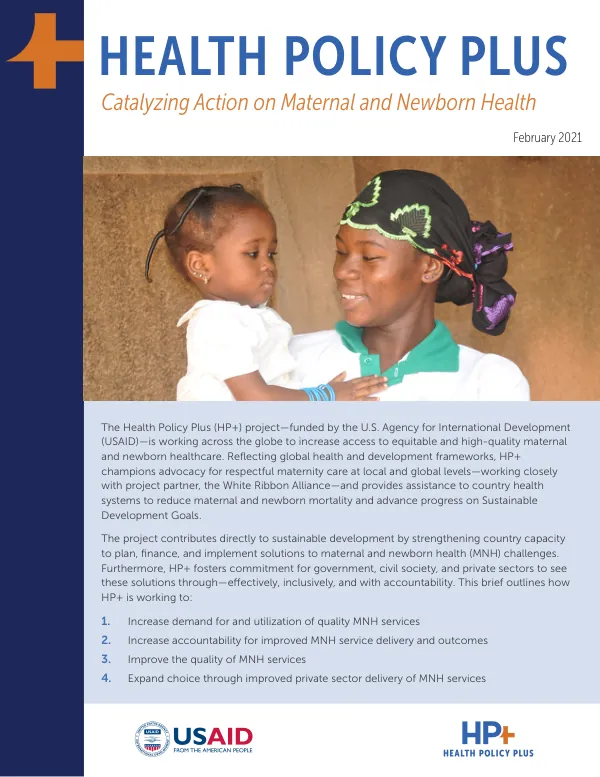
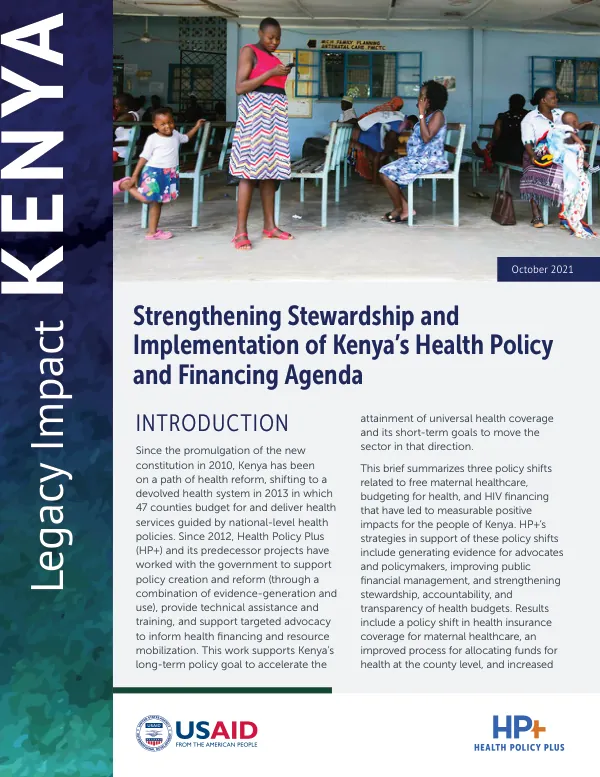
This system allows 47 counties to budget for and deliver health services guided by national-level health policies. Health Policy Plus (HP+) and its predecessor projects have worked with the government to support policy creation and reform, provide technical assistance and training, and support targeted advocacy to inform health financing and resource mobilization. The goal of these efforts is to accelerate the attainment of universal health coverage and move the sector in that direction. HP+ has supported three policy shifts related to free maternal healthcare, budgeting for health, and HIV financing, which have led to measurable positive impacts for the people of Kenya. These policy shifts include the creation of Linda Mama, a program that provides free maternal healthcare services to pregnant uninsured Kenyan women and their newborns for up to one year. The Linda Mama program was first introduced in 2013, with the goal of removing fees for maternity services at all public facilities. The program was initially supported by HP+ and its predecessor project, which provided data to support the rollout of the program. The program was later redesigned to include private for-profit and faith-based providers, giving women more choices and improving the quality of services. The program has led to a 44 percent increase in the use of maternal health services in public facilities and a decline in maternal mortality ratio from 472 to 358 deaths per 100,000 live births between 2009 and 2014. In addition to the Linda Mama program, HP+ has also supported the adoption of program-based budgeting methods in Kenya's counties. This approach allocates resources under defined strategic goals and provides sub-program categories for priority health areas. HP+ worked with the Kenya School of Government to create a program-based budgeting template, curriculum, and facilitation guide for training staff in 26 of 47 counties. The project also provided support to county departments of health on advocating to political leaders on allocation needs and setting up health sector working groups. The results of these efforts include a policy shift in health insurance coverage for maternal healthcare, an improved process for allocating funds for health at the county level, and increased financial sustainability for Kenya's HIV response. These results and impacts contribute to Kenya's progress toward universal health coverage. The government of Kenya allocates resources to Linda Mama every year and has integrated the program within its universal health coverage agenda and the Kenya Vision 2030 objective to cover 1.36 million mothers and babies by 2022. The implementation of program-based budgeting has also led to significant improvements in health spending and outcomes in Kenya's counties. The government-endorsed policy requires all counties to switch from line-item budgeting to program-based budgeting methods. HP+ has provided significant support to county staff to become proficient in program-based budgeting, which has enabled them to allocate resources under defined strategic goals and provide sub-program categories for priority health areas. The lessons learned from these efforts highlight the importance of political vision and commitment in policy adoption and implementation. Engaging stakeholders through appropriate evidence-based data fosters policy buy-in and funding. Feedback gained through program evaluation allowed the government and HP+ to adapt the program to incorporate client concerns and facilitate sustainability. These lessons can inform future health policy and reform efforts in Kenya and other countries.
Related documents