GOVERNMENT OF KENYA
Health Policy Plus: Catalyzing Action on Maternal and Newborn Health
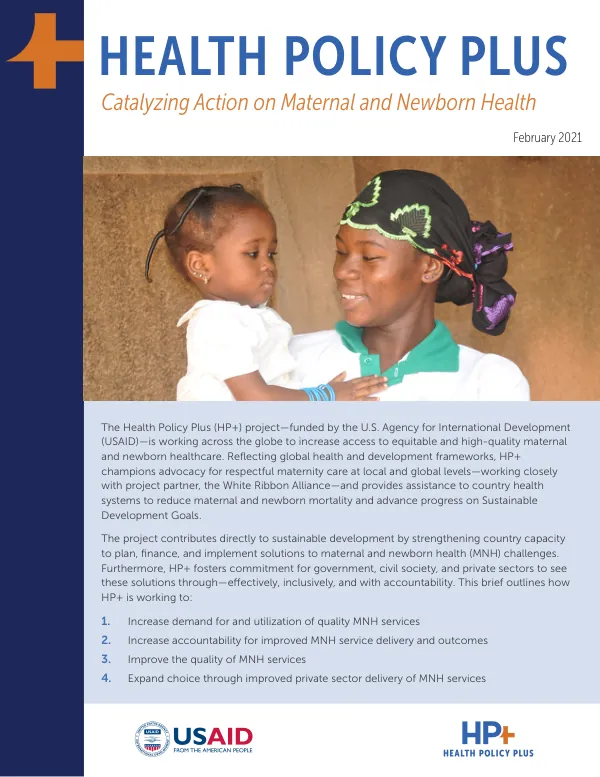
The Health Policy Plus (HP+) project is a global initiative funded by the U.S.
2021 · 6 pages
Sign in to readA free account is required to download.
Abstract
Agency for International Development (USAID) to increase access to equitable and high-quality maternal and newborn healthcare. HP+ works with project partners, including the White Ribbon Alliance, to advocate for respectful maternity care at local and global levels. The project aims to reduce maternal and newborn mortality and advance progress on Sustainable Development Goals. HP+ contributes to sustainable development by strengthening country capacity to plan, finance, and implement solutions to maternal and newborn health (MNH) challenges. The project fosters commitment from government, civil society, and private sectors to see these solutions through effectively, inclusively, and with accountability. HP+ focuses on four key areas: increasing demand for and utilization of quality MNH services, increasing accountability for improved MNH service delivery and outcomes, improving the quality of MNH services, and expanding choice through improved private sector delivery of MNH services. In Kenya, HP+ assisted the Ministry of Health and National Health Insurance Fund to redesign the Linda Mama program, which provides free maternal health services to pregnant women. The program aims to decrease maternal mortality in Kenya by offering an insurance card that will last up to a year after birth for postnatal and well-baby services. HP+ helped the ministry to cost the benefits package and prepare policy documents related to the redesign. As of July 2020, more than 1.1 million women across Kenya had received life-saving services through Linda Mama. HP+ also collaborated with the National Team for Acceleration of Poverty Reduction (TNP2K) in Indonesia to conduct an assessment of the national health insurance scheme, Jaminan Kesehatan Nasional (JKN). The assessment provides comprehensive recommendations that highlight improved access to services for pregnant women. In Malawi and Pakistan, HP+ organized citizen hearings on respectful maternity care, which enabled citizens to voice their concerns related to accountability, abuse, and disrespect experienced by pregnant women. Increasing accountability for improved maternal and newborn health service delivery and outcomes is crucial for sustaining reductions in maternal deaths and achieving high-impact MNH goals. HP+ worked with stakeholders in Indonesia and Pakistan to increase the use of data to make evidence-based decisions, which helps to improve accountability within MNH. Transparency and availability of quality data help to avoid misuse of the healthcare system and improve provision of quality care. In Nigeria, HP+ provided comprehensive support to strengthen financing, governance, and capacity for improved primary care and MNH. The project assisted the government in designing, piloting, and rolling out a comprehensive training and mentoring program to train Nigeria's other 34 states. As of July 2020, Abia, Osun, and the FCT improved budget allocation by over US$52 million and mobilized over US$8 million in new funds for health. HP+ also worked with the Ministry of Health and Ministry of Home Affairs in Indonesia to support minimum service standards for health, including MNH. The project collected detailed cost data for the minimum service standards and supported monitoring of all district-level performance through a dashboard. In Pakistan, HP+ mobilized nearly 250,000 women and girls to generate information on their priorities for reproductive, maternal, and newborn health, which was used to inform provincial and state-level policymakers on the changes needed to ensure that care is provided in a way that takes into account women's and girls' views and expectations.