USAID DEC
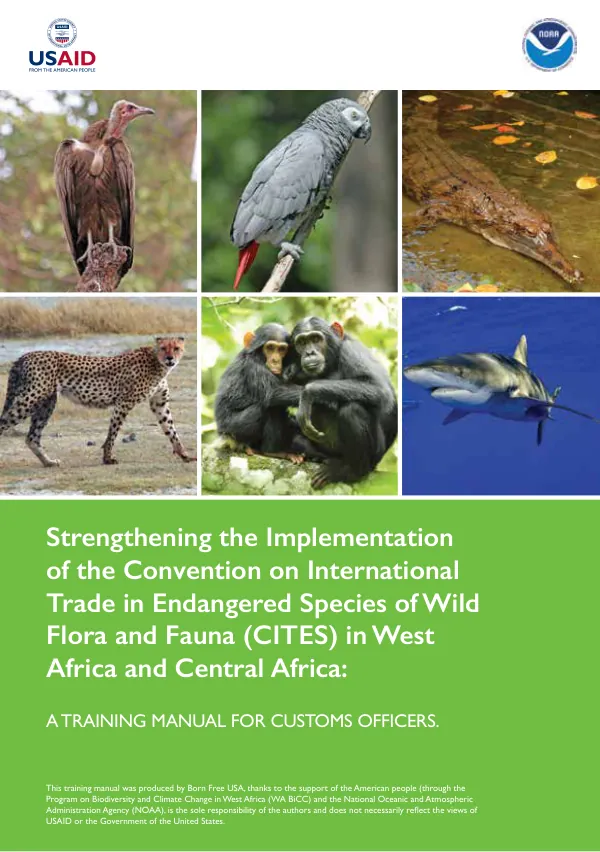
Strengthening the Implementation of the Convention on International Trade in Endangered Species of Wild Flora and Fauna (CITES) in West Africa and Central Africa: A Training Manual for Customs Officers
Sign inTETRA TECH
Strengthening the Implementation of the Convention on International Trade in Endangered Species of Wild Flora and Fauna (CITES) in West Africa and Central Africa: A Training Manual for Customs Officers
The Convention on International Trade in Endangered Species of Wild Fauna and Flora (CITES) is a critical international agreement aimed at regulating the global trade of endangered species.
2019 · 185 pages
Sign in to readA free account is required to download.
Abstract
In West Africa and Central Africa, the implementation of CITES is crucial to combat wildlife trafficking and protect threatened species. A training manual for customs officers has been developed to strengthen the implementation of CITES in these regions. The manual is designed to equip customs officers with the necessary skills to train their colleagues and other agencies on CITES regulations and enforcement. The training program is based on a "train the trainer" approach, which aims to build a network of trainers who can cascade training to others in their home countries. The manual consists of 11 modules, each covering a specific aspect of CITES implementation, including the basics of CITES, species identification, and enforcement techniques. The training modules are designed to be flexible and adaptable to the needs of different target audiences, including customs officers, wildlife authorities, and other agencies involved in wildlife enforcement. The modules can be used individually or in combination, depending on the needs of the participants. The manual also provides guidance on how to use the modules, including the use of PowerPoint presentations and visual aids. To carry out the training, resources such as laptops, projectors, and screens are required. It is also recommended to use examples of confiscated items, such as ivory and pangolin scales, to illustrate key concepts. Guest speakers, particularly experts in species identification, risk profiling, and evidence management, are encouraged to participate in the training. The planning of workshops involves identifying the locations and recipients of the training. For customs officers, the main international airports and container sea ports are likely to be the primary focus, while for wildlife authorities, those based at these ports or airports may be the target audience. Police units responsible for investigating and prosecuting wildlife cases may also be included. The training manual is a critical tool for building the capacity of customs officers and other agencies to implement CITES effectively in West Africa and Central Africa. By equipping these officers with the necessary skills and knowledge, the manual aims to contribute to the conservation of threatened species and the prevention of wildlife trafficking in the region. The training program is designed to be sustainable and adaptable to the evolving nature of wildlife trafficking. The manual will need to be updated periodically to reflect changes in CITES regulations, new species being added to the convention, and emerging methods of smuggling and trafficking. By building a network of trainers who can cascade training to others, the manual aims to create a lasting impact on the implementation of CITES in the region. In addition to the training manual, a wildlife crime threat assessment was carried out in 7 of the 15 ECOWAS countries in 2017. The assessment identified a lack of effective capacity building to support wildlife enforcement capability in these countries. The training manual is designed to address this gap and provide customs officers and other agencies with the necessary skills to implement CITES effectively. The manual is the result of a collaboration between Born Free USA and the American people, with support from the Program on Biodiversity and Climate Change in West Africa (WA BiCC) and the National Oceanic and Atmospheric Administration Agency (NOAA). The views expressed in the manual do not necessarily reflect those of USAID or the Government of the United States.