CARE
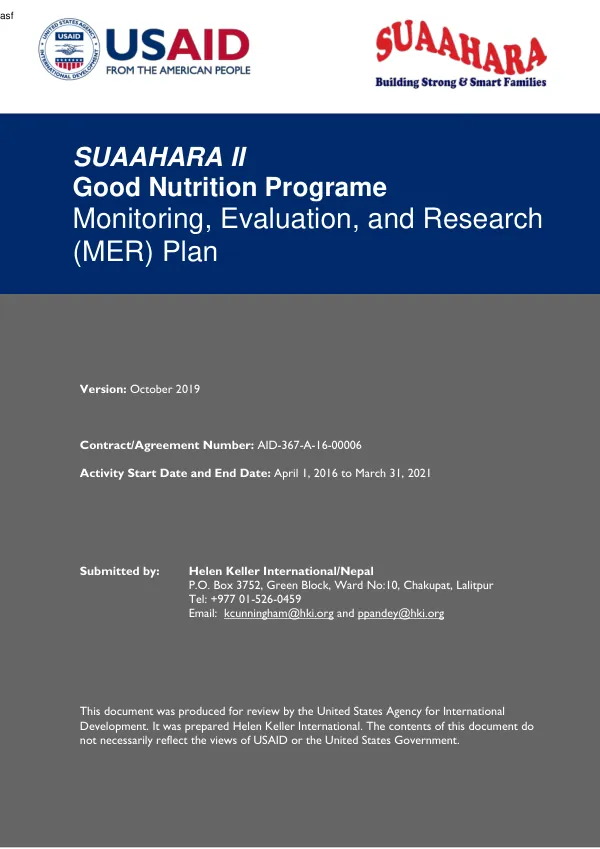
Suaahara II M&E Plan
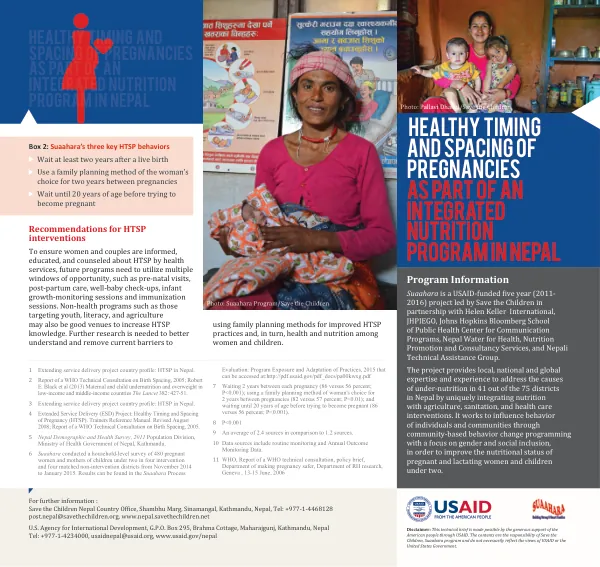
Suaahara II is a five-year USAID-funded program aimed at reducing the prevalence of low birth weight, stunting, wasting, and underweight among children under 5 years of age, as well as underweight among women of reproductive age and anemia among these categories of women and children.
2018 · 62 pages
Sign in to readA free account is required to download.
Abstract
The program incorporates a focus on adolescent girls and shifts from a mother/child dyad approach to a whole-household approach, engaging fathers and grandparents. Suaahara II also promotes greater gender equality and social inclusion by targeting women and disadvantaged groups. The program started with a district-wide approach in 40 of Nepal's 75 districts, but due to the country's transition to a decentralized federal system, Suaahara II is now operational in 42 of Nepal's 77 districts, coordinating with 389 rural and urban municipalities and 3,353 wards. The program will be delivered through universal and intensive coverage of households in the 1,000-day period between birth and a child's second birthday by Government of Nepal (GoN) and SII frontline workers, strengthening existing health systems and service points, and targeted social and behavior change approaches. Suaahara II will build GoN capacity to deliver high-quality services, strengthening governance, coordination, and delivery structures and standards that support sustainable nutritional improvements. The program consortium partners include Helen Keller International (HKI), CARE, Equal Access, Environment and Public Health Organization (ENPHO), FHI360, Vijaya Development Resource Center (VDRC), and Nutrition Technical Assistance Group (NTAG), with HKI leading the consortium and all monitoring, evaluation, and research (MER) activities. The Suaahara II Theory of Change outlines the activities, outcomes, and preconditions needed to drive improvements in the nutritional status of mothers and children under 5 years of age in Nepal. The theory of change includes shifts in community capacity, health, nutrition, and water, sanitation, and hygiene (WASH) practices, as well as governance, decentralization, and multi-sector nutrition prioritization. Key indicators and targets for Suaahara II include improved household nutrition, WASH, and health practices, increased household use of quality nutrition and health services, increased household access to diverse and nutrient-rich foods, and accelerated rollout of the Multi-Sector Nutrition Plan (MSNP) through strengthened local governance. The program will also focus on improving service quality and reach, including the promotion of quality reproductive health services, improved health information systems, and long-term community and national shifts towards multi-sector nutrition prioritization. The Suaahara II MER Plan outlines the monitoring, evaluation, and research activities that will be conducted to track progress towards the program's objectives. The plan includes a system overview, key indicators and targets, data for monitoring, evaluation, and research, data limitations and ethics, data quality assurance, data analysis, reporting, and use, stakeholder coordination, capacity building, learning and adapting, and MER team structure, roles, and responsibilities. The MER team will be responsible for designing and implementing MER activities, including data collection, analysis, and reporting, as well as providing input into the design and implementation of MER activities by consortium partners. The team will also engage with stakeholders to ensure the use of data for learning and adaptation. The Suaahara II MER Plan will be implemented over the five-year period of the program, with a focus on tracking progress towards the program's objectives and making adjustments as needed to ensure the program's success. The plan will also provide a framework for the program's evaluation and research activities, including the use of data for learning and adaptation. The program's MER activities will be conducted in collaboration with consortium partners, including HKI, CARE, Equal Access, ENPHO, FHI360, VDRC, and NTAG, as well as with the Government of Nepal and other stakeholders. The MER team will work closely with these partners to ensure the effective implementation of the MER plan and the use of data for learning and adaptation. The Suaahara II MER Plan is a critical component of the program's overall strategy, providing a framework for tracking progress towards the program's objectives and making adjustments as needed to ensure the program's success. The plan will also provide a foundation for the program's evaluation and research activities, including the use of data for learning and adaptation. The program's MER activities will be conducted in accordance with the principles of the MER plan, including the use of data for learning and adaptation, stakeholder coordination, capacity building, and MER team structure, roles, and responsibilities. The MER team will work closely with consortium partners and stakeholders to ensure the effective implementation of the MER plan and the use of data for learning and adaptation. The program's MER