USAID DEC
Healthy Timing and Spacing of Pregnancies as part of an Integrated Nutrition Program in Nepal
Sign inHELLEN KELLER INTERNATIONAL
Healthy Timing and Spacing of Pregnancies as part of an Integrated Nutrition Program in Nepal
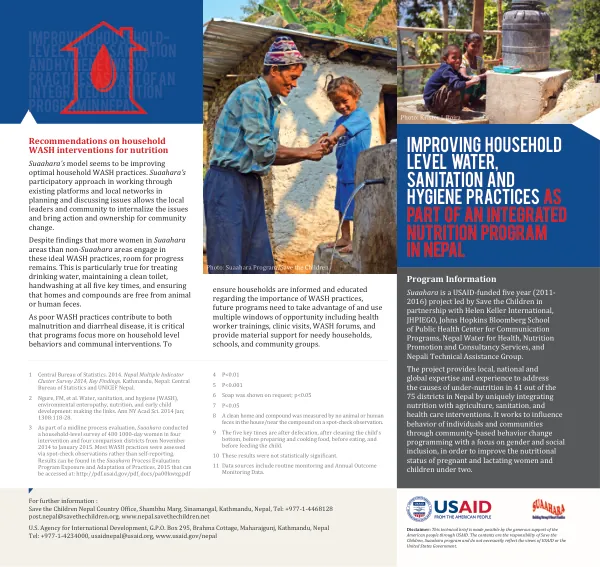
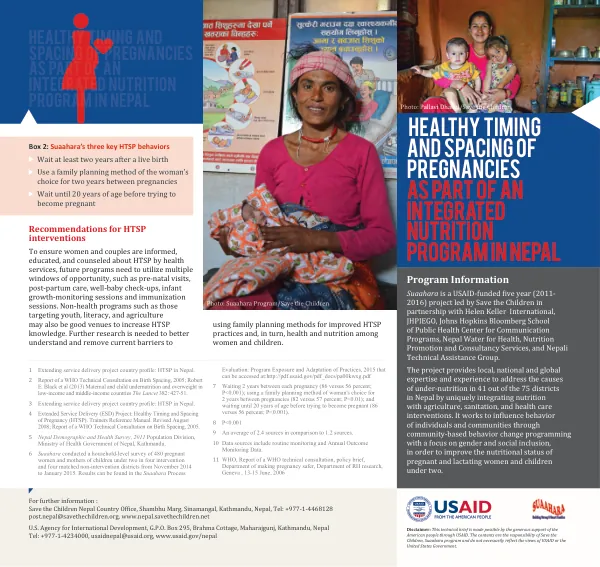
The Suaahara project, a five-year initiative led by Save the Children in partnership with various organizations, aimed to address under-nutrition in 41 districts of Nepal by integrating nutrition with agriculture, sanitation, and health care interventions.
2015 · 2 pages
Sign in to readA free account is required to download.
Abstract
The project focused on improving the nutritional status of pregnant and lactating women and children under two through community-based behavior change programming, with a focus on gender and social inclusion. Research has shown that becoming pregnant too young or very soon after a previous birth places mothers and newborns at a higher risk of health complications. Infants born close together may be deprived of the benefits of breastfeeding for the recommended two years, and women face higher risks of anemia, premature rupture of membranes, and miscarriage. In Nepal, many women become pregnant during adolescence and do not use any form of contraception even during periods when they do not wish to become pregnant. Healthy Timing and Spacing of Pregnancies (HTSP) is a key family planning intervention that can help women and families to delay or space their pregnancies. HTSP allows for the healthiest outcomes for women, newborns, infants, and children, within the context of free and informed choice and taking into account fertility intentions and desired family size. Suaahara has exposed women who are pregnant or have a child under two years of age to family planning education and has improved knowledge about HTSP. Suaahara's achievements in HTSP include increasing the number of women who have heard the three key HTSP messages, including waiting 2 years between each pregnancy. More women in Suaahara areas have received counseling from a health professional on HTSP and have obtained HTSP-related advice/counseling from more than one source. However, despite apparent gains in access and knowledge, use of family planning methods was low in Suaahara and comparison areas, with fewer than 1 in 4 women using family planning methods. The Suaahara project promotes and supports integrated family planning, health, and nutrition counseling services provided at health facilities and by Female Community Health Volunteers (FCHVs) in more than half of the districts in Nepal. The four key interventions for HTSP are increasing the capacity of health service providers on HTSP and family planning methods, improving the quality of and access to health services, including family planning services and HTSP, building the capacity of FCHVs on HTSP, and creating demand for HTSP services in 1000 days women. The project has trained service providers on integrating counseling on HTSP and long-term family planning methods into antenatal care, postnatal care, family planning, and child health services. Family planning kits, HTSP posters, and brochures are provided to health facilities. Suaahara has also provided training for Health Facility Operations and Management Committees to identify and overcome key management issues in health facilities and primary health care/outreach clinics. The goal was to improve the quality of and access to integrated nutrition, health, and family planning services in communities with little access to health services. Using various Social Behavior Change Communication strategies, including interpersonal counseling, social mobilization, and mass media (radio), Suaahara promotes three key HTSP behaviors that are based on recommendations made by the World Health Organization (WHO) and adapted for the local context. The project has also trained FCHVs to counsel 1000 days women on 3 key HTSP messages using a discussion card developed by Suaahara under the leadership of Family Health Division in the Department of Health Services.