USAID DEC
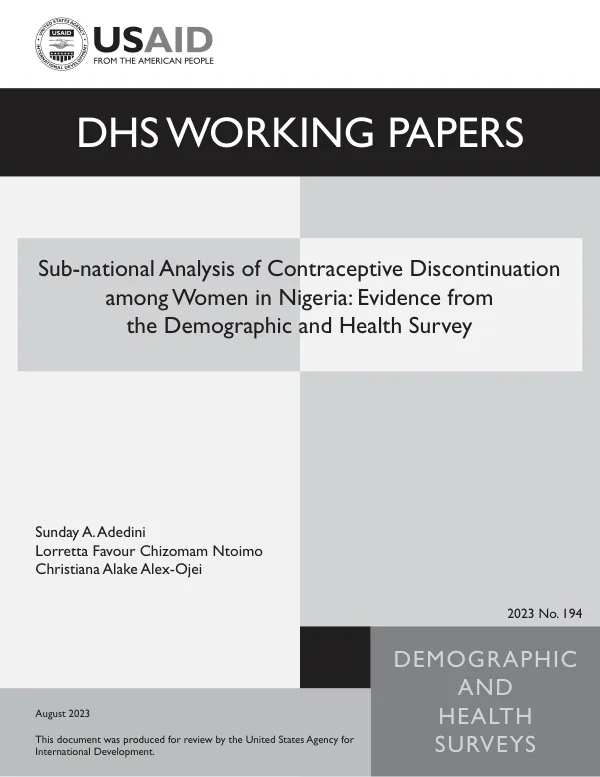
Sub-national Analysis of Contraceptive Discontinuation among Women in Nigeria: Evidence from the Demographic and Health Survey
Sign inICF
Sub-national Analysis of Contraceptive Discontinuation among Women in Nigeria: Evidence from the Demographic and Health Survey
Sub-national Analysis of Contraceptive Discontinuation among Women in Nigeria: Evidence from the Demographic and Health Survey The modern contraceptive prevalence rate (mCPR) in Nigeria is 12%, one of the lowest in the world.
2023 · 46 pages
Sign in to readA free account is required to download.
Abstract
The contraceptive discontinuation rate among women in Nigeria is high at 41%. A sub-national analysis of Nigeria's mCPR reveals a dismal situation, with mCPR ranging from 2% in Sokoto State (North West) and Yobe State (North East) to 29% in Lagos State (South West). This study aimed to investigate the reasons and determinants of contraceptive discontinuation across sub-national levels in Nigeria. Data for the study came from the individual women's recode of the 2018 Nigeria Demographic and Health Survey, with a weighted total of 180,999 events in the 5 years before the survey. The data included 10,384 episodes of contraceptive use and 6,365 episodes of discontinuation among 4,974 women aged 15-49. The Cox proportional hazards model was used to examine the relationship between the dependent variable (contraceptive discontinuation) and the explanatory variables. The results show a substantial disparity in contraceptive discontinuation episodes across the six regions of Nigeria, with the highest rate in the South West (28.0%) and the lowest in the North East (11.1%). The discontinuation rate for all methods was lowest in the South West (32.5%) and highest in the North West (50.1%). Across regions, the highest discontinuation rate was attributed to pregnancy or fertility-related reasons. The Cox models indicate that, compared to the South West Region, the risks of discontinuing contraceptives were significantly higher in the North West, South, and North East, with hazard ratios ranging from 1.3 to 1.5. The study suggests the need for context-specific family planning programming that takes into account the country's diversity to address the problem of contraceptive discontinuation and ensure better reproductive health outcomes in Nigeria. The study highlights the importance of understanding the reasons and determinants of contraceptive discontinuation in Nigeria, particularly in the context of the country's diversity. The findings suggest that contraceptive discontinuation is a significant public health concern in Nigeria, with substantial disparities across regions. The study's results have implications for the development of context-specific family planning programming that addresses the needs of women in different regions of Nigeria. The study's findings are consistent with previous research on contraceptive discontinuation in low- and middle-income countries. A study of 25 low- and middle-income countries found that 38% of women discontinued contraceptive use within 12 months, with 55% and 64% discontinuing use within 24 and 36 months, respectively. In Nigeria, the modern contraceptive prevalence rate (mCPR) is 12%, one of the lowest in the world. The study's results have implications for the development of context-specific family planning programming that addresses the needs of women in different regions of Nigeria. The study's findings suggest that contraceptive discontinuation is a significant public health concern in Nigeria, with substantial disparities across regions. The study's results highlight the need for context-specific family planning programming that takes into account the country's diversity to address the problem of contraceptive discontinuation and ensure better reproductive health outcomes in Nigeria.