USAID
Success Story
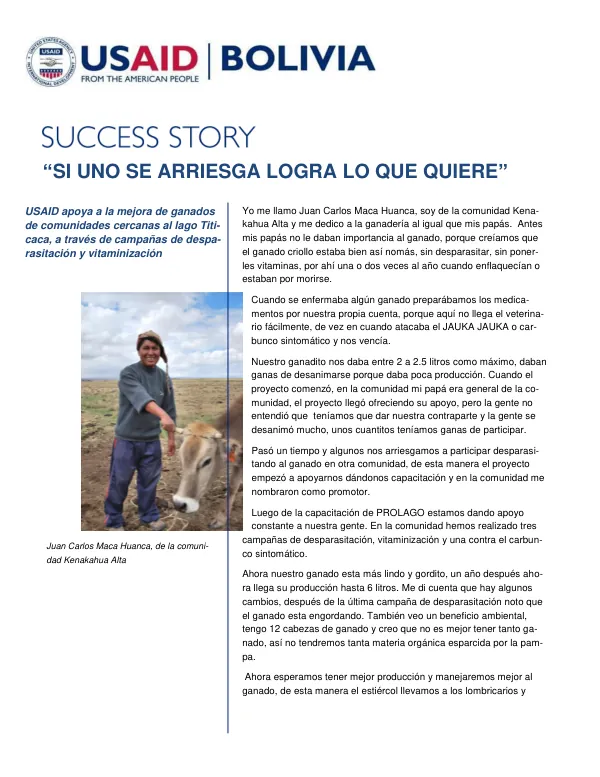
Juan Carlos Maca Huanca, a resident of the Kenakahua Alta community, has dedicated his life to cattle farming, following in the footsteps of his parents.
2013 · 2 pages
Sign in to readA free account is required to download.
Abstract
Initially, his parents did not prioritize the health of their cattle, believing that the local breed was sufficient without desparasitization, vitaminization, or regular veterinary care. When their cattle fell ill, they would prepare medications on their own due to the limited availability of veterinarians in the area. The community was often plagued by diseases such as Jauka Jauka and carbuncle, which would decimate their herds. The cattle would typically produce between 2 to 2.5 liters of milk, leading to frustration and a desire to give up. However, with the introduction of the USAID-supported project, the community began to receive support and training. Juan Carlos' father, who was a community leader at the time, was initially hesitant to participate, but eventually, some community members took the initiative to desparasitize their cattle in a neighboring community. This marked the beginning of the project's involvement, which provided training and support to the community. Following the training provided by PROLAGO, Juan Carlos was appointed as a promoter and has since been actively involved in supporting his community. The community has conducted three campaigns of desparasitization, vitaminization, and a campaign against carbuncle. As a result, the cattle have improved significantly, with production increasing to 6 liters per year. Juan Carlos notes that the cattle are now healthier and more robust, and he has observed a positive impact on the environment, with reduced waste and a decrease in the amount of organic matter scattered throughout the pasture. The community is now working towards improving their cattle production and management, with plans to utilize the manure in lombricarios and biodigestors to aid in the descontamination of the Katari River. Juan Carlos credits the project's technical team for their guidance and quotes one of their phrases, "why have ten unproductive cattle when you can have two improved ones?" He is confident that he will be able to continue the project's work even after it concludes, having gained the necessary skills and knowledge through the training provided.
Related documents
Documents in this collection
 2015
2015USAID DEC
Comprobación de los mapas de zonificación agroecológica generados por el CISAS para los rubros de café, cacao, ganadería, piscicultura y ciclo corto y el mapa de uso y cobertura vegetal generado por el MAE del año 2014
Open record 2022
2022USAID DEC