INTERNATIONAL ORGANIZATION FOR MIGRATION
Success Story: Humanitarian Transportation Bridge Enables Tsunami Response
Humanitarian Transportation Bridge Enables Tsunami Response to Remote Islands The USAID-funded humanitarian transportation bridge played a crucial role in facilitating the delivery of emergency relief commodities to tsunami-affected communities in Indonesia's remote Mentawai Islands.
2011 · 1 pages
Sign in to readA free account is required to download.
Abstract
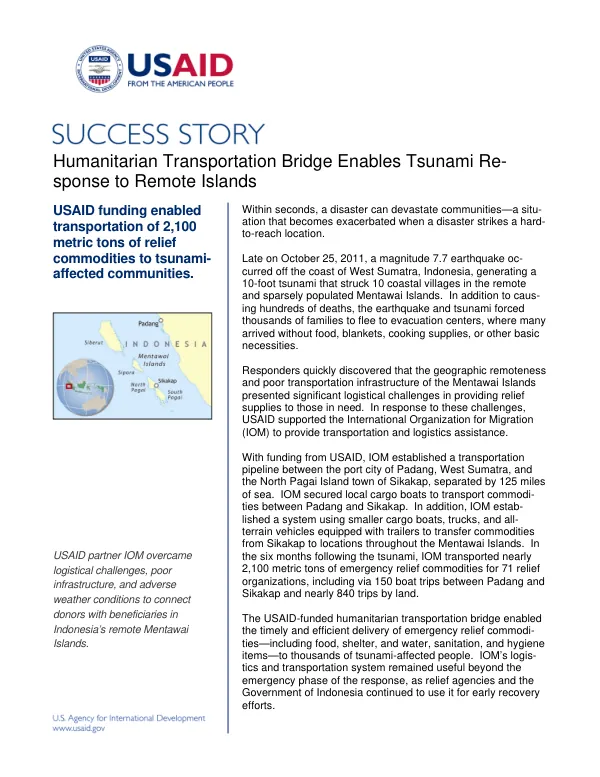
The transportation pipeline, established between the port city of Padang, West Sumatra, and the North Pagai Island town of Sikakap, spanned 125 miles of sea and connected donors with beneficiaries in the affected areas. Logistical challenges, poor infrastructure, and adverse weather conditions posed significant obstacles to responders in the aftermath of the magnitude 7.7 earthquake that occurred off the coast of West Sumatra on October 25, 2011. The resulting 10-foot tsunami struck 10 coastal villages, causing hundreds of deaths and displacing thousands of families. Responders quickly discovered that the geographic remoteness and poor transportation infrastructure of the Mentawai Islands presented significant logistical challenges in providing relief supplies to those in need. With funding from USAID, the International Organization for Migration (IOM) established a transportation pipeline to address these challenges. IOM secured local cargo boats to transport commodities between Padang and Sikakap, and established a system using smaller cargo boats, trucks, and all-terrain vehicles equipped with trailers to transfer commodities from Sikakap to locations throughout the Mentawai Islands. In the six months following the tsunami, IOM transported nearly 2,100 metric tons of emergency relief commodities for 71 relief organizations. The USAID-funded humanitarian transportation bridge enabled the timely and efficient delivery of emergency relief commodities, including food, shelter, and water, sanitation, and hygiene items, to thousands of tsunami-affected people. IOM's logistics and transportation system remained useful beyond the emergency phase of the response, as relief agencies and the Government of Indonesia continued to use it for early recovery efforts. The transportation bridge played a critical role in facilitating the delivery of relief supplies to remote and hard-to-reach areas, demonstrating the importance of effective logistics and transportation in humanitarian response efforts. The success of the humanitarian transportation bridge in the Mentawai Islands highlights the need for innovative and flexible logistics solutions in responding to disasters in remote and hard-to-reach areas. The bridge's ability to adapt to changing circumstances and connect donors with beneficiaries in a timely and efficient manner is a testament to the importance of effective collaboration and coordination in humanitarian response efforts.