USAID DEC
Success Story – Small Steps Towards Big Change: Community Leader in Ribáuè Stimulates Discussion on Stigma and Gender-Based Violence with SCIP Support
Sign inUSAID DEC
Success Story – Small Steps Towards Big Change: Community Leader in Ribáuè Stimulates Discussion on Stigma and Gender-Based Violence with SCIP Support
The SCIP project's Behavior Change Communication team has been implementing community-level discussions to raise awareness on Stigma and Gender-Based Violence (GBV) since the end of 2011.
2013 · 1 pages
Sign in to readA free account is required to download.
Abstract
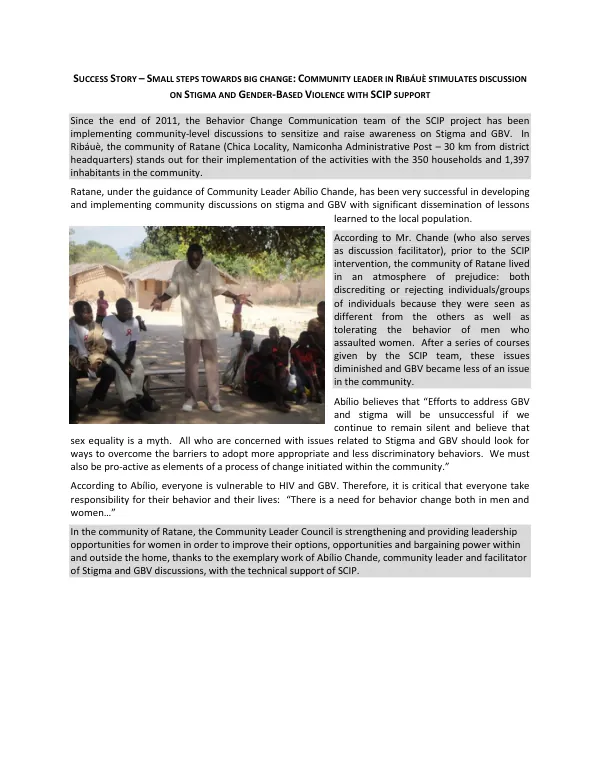
In Ribáuè, the community of Ratane has been particularly successful in developing and implementing community discussions on stigma and GBV. The community, located in Chica Locality, Namiconha Administrative Post, has a population of 1,397 inhabitants and 350 households. Under the guidance of Community Leader Abílio Chande, Ratane has been able to sensitize and raise awareness on stigma and GBV among the local population. Prior to the SCIP intervention, the community lived in an atmosphere of prejudice, where individuals and groups were discredited or rejected due to perceived differences. However, after a series of courses given by the SCIP team, these issues diminished, and GBV became less of an issue in the community. Abílio Chande believes that addressing GBV and stigma requires a proactive approach, where individuals take responsibility for their behavior and lives. He emphasizes that everyone is vulnerable to HIV and GBV, and that behavior change is necessary for both men and women. The Community Leader Council in Ratane is strengthening and providing leadership opportunities for women, improving their options, opportunities, and bargaining power within and outside the home. The SCIP project's technical support has been instrumental in facilitating the community discussions and raising awareness on stigma and GBV. Abílio Chande's leadership and facilitation skills have been exemplary, and his efforts have contributed to a significant reduction in GBV in the community. The success of Ratane's community discussions serves as a model for other communities in Ribáuè and beyond, highlighting the importance of community-led initiatives in addressing social issues. The community's efforts to address stigma and GBV have also led to improved relationships between men and women, with a greater emphasis on mutual respect and understanding. The SCIP project's support has enabled the community to develop a more inclusive and equitable environment, where everyone has the opportunity to participate and contribute. The success of Ratane's community discussions demonstrates the potential for community-led initiatives to drive positive change and promote social cohesion.