MINISTRY OF PUBLIC HEALTH
Success Story: Southeast Asia
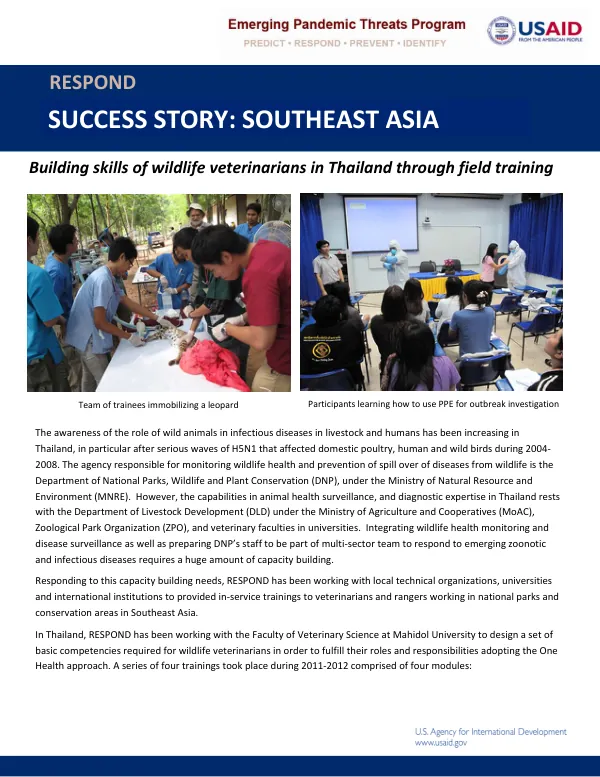
The awareness of the role of wild animals in infectious diseases in livestock and humans has been increasing in Thailand, particularly after serious waves of H5N1 that affected domestic poultry, human, and wild birds during 2004-2008.
2012 · 2 pages
Sign in to readA free account is required to download.
Abstract
The Department of National Parks, Wildlife and Plant Conservation (DNP) under the Ministry of Natural Resource and Environment (MNRE) is responsible for monitoring wildlife health and preventing the spill over of diseases from wildlife. However, the capabilities in animal health surveillance and diagnostic expertise in Thailand rest with the Department of Livestock Development (DLD) under the Ministry of Agriculture and Cooperatives (MoAC), Zoological Park Organization (ZPO), and veterinary faculties in universities. In response to the capacity building needs, RESPOND has been working with local technical organizations, universities, and international institutions to provide in-service trainings to veterinarians and rangers working in national parks and conservation areas in Southeast Asia. In Thailand, RESPOND has been working with the Faculty of Veterinary Science at Mahidol University to design a set of basic competencies required for wildlife veterinarians in order to fulfill their roles and responsibilities adopting the One Health approach. A series of four trainings took place during 2011-2012, comprising of four modules: orientation, core professional principles and knowledge, wildlife diseases and wildlife studies, and the One Health approach; wildlife capture and immobilization techniques; wildlife epidemiology and surveillance; and field experience for smart patrol, forensic investigation, and outbreak investigation. The 15 participants attending the trainings were recently recruited veterinarians stationed in 14 DNP regional offices across Thailand and 1 from the Bangkok central office. Most of them have been providing treatment to sick wild animals seized from poachers or wildlife traffickers kept in DNP wildlife reception centers, and few have conducted limited disease surveillance in captive animals. RESPOND supported trainings were conducted through a combination of presentations, field visits, and hands-on activities that served to build basic necessary skills for wildlife veterinarians. Subject matter experts and trainers were from universities in Thailand, Ministry of Public Health, RESPOND SEA Office, Tufts University, University of Minnesota, OIE, FAO Regional Office for Asia and Pacific, and many international consultants. The participants found this series of trainings beneficial to their immediate work. RESPOND has enhanced the capacity of the first cohort of wildlife veterinarians in Thailand and equipped them with knowledge and skills for their new challenging tasks. The trainings have also fostered a network of DNP vets that can help each other when needed. The participants' feedback about the capacity building activities highlights the effectiveness of the trainings in building the capacity of wildlife veterinarians in Thailand. The trainings have equipped them with the necessary skills and knowledge to conduct disease surveillance, capture and immobilize wild animals, and work together across disciplines and sectors to prevent the spread of infectious diseases. The trainings have also led to the development of a plan to conduct surveillance on Nipah virus among bats in one of the DNP regions. The training on bat trapping with harp trap and the specimen collection process was found to be very useful by the participants. The overall impact of the trainings has been to enhance the capacity of wildlife veterinarians in Thailand and equip them with the necessary skills and knowledge to prevent the spread of infectious diseases and protect human health.