USAID DEC
Success Story: University Networks
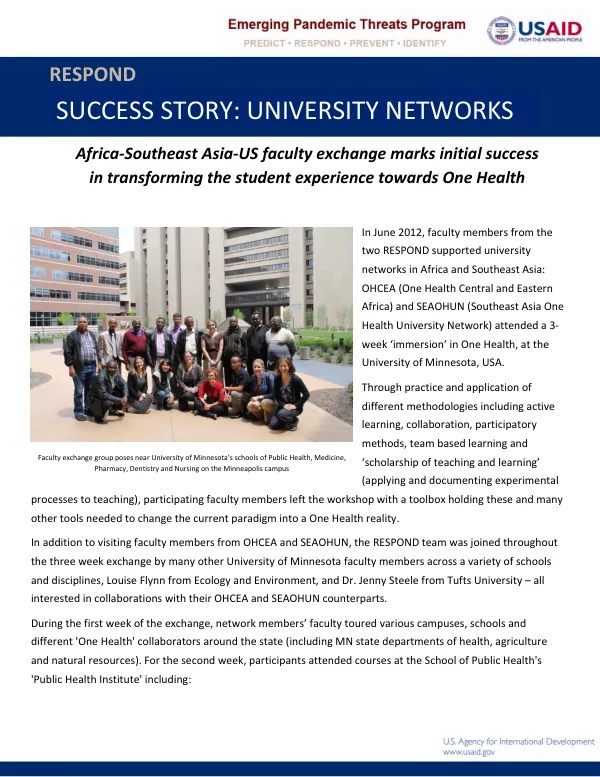
The RESPOND-supported university networks in Africa and Southeast Asia embarked on a three-week immersion program in One Health at the University of Minnesota in June 2012.
2012 · 3 pages
Sign in to readA free account is required to download.
Abstract
Faculty members from the OHCEA (One Health Central and Eastern Africa) and SEAOHUN (Southeast Asia One Health University Network) attended the program, which aimed to equip them with the necessary tools and methodologies to adopt the One Health approach in their home institutions. During the first week, network members toured various campuses, schools, and One Health collaborators around the state, including the Minnesota state departments of health, agriculture, and natural resources. This exposure provided them with a comprehensive understanding of the One Health concept and its applications in different settings. The second week focused on courses at the School of Public Health's Public Health Institute, where participants attended sessions on topics such as farm-to-table study programs, food system defense, and global food systems. The third week comprised a curriculum development and faculty development workshop led by Deb Wingert from the Center for Teaching and Learning at the University of Minnesota. The workshop introduced a new teaching and learning paradigm for the 21st century, emphasizing methodologies to improve multi-disciplinary collaboration consistent with the One Health approach. Participants self-selected into four topic areas based on their interests and formed groups to develop courses on One Health leadership, ecosystem health, risk analysis, and epidemiology for outbreak response. The workshop design served two purposes: to transition from the traditional lecture-based learning paradigm to an active, team-based, and collaborative approach, and to demonstrate and apply collaborative cross-disciplinary course development methods consistent with the university networks' vision of One Health. The experience was a tremendous success, with faculty participants committed to translating and applying the methodologies and lessons learned to their home institutions. As these methodologies are applied, they represent a paradigm shift towards applying the One Health concept into the student experience across the globe.
Related documents