USAID DEC
Success Story: USID leads efforts to improve the quality of preschool education in Albania
Sign inMINISTRY OF EDUCATION AND CULTURE
Success Story: USID leads efforts to improve the quality of preschool education in Albania
USAID leads efforts to improve the quality of preschool education in Albania.
2020 · 1 pages
Sign in to readA free account is required to download.
Abstract
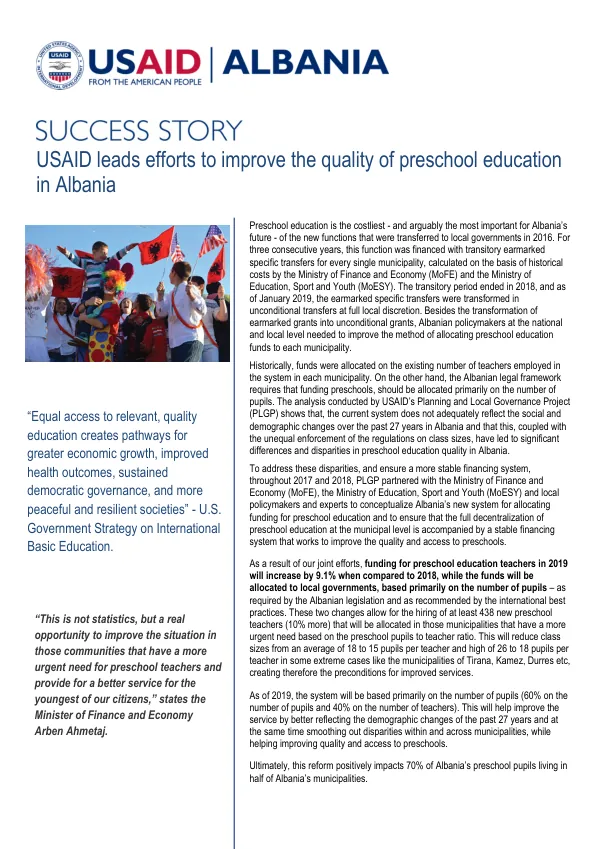
Preschool education is the costliest and arguably the most important function transferred to local governments in 2016. For three consecutive years, this function was financed with transitory earmarked specific transfers for every single municipality, calculated on the basis of historical costs by the Ministry of Finance and Economy (MoFE) and the Ministry of Education, Sport and Youth (MoESY). The transitory period ended in 2018, and as of January 2019, the earmarked specific transfers were transformed into unconditional transfers at full local discretion. Historically, funds were allocated on the existing number of teachers employed in the system in each municipality. However, the Albanian legal framework requires that funding preschools be allocated primarily on the number of pupils. The analysis conducted by USAID's Planning and Local Governance Project (PLGP) shows that the current system does not adequately reflect the social and demographic changes over the past 27 years in Albania. This, coupled with the unequal enforcement of the regulations on class sizes, has led to significant differences and disparities in preschool education quality in Albania. To address these disparities, and ensure a more stable financing system, PLGP partnered with the Ministry of Finance and Economy (MoFE), the Ministry of Education, Sport and Youth (MoESY), and local policymakers and experts to conceptualize Albania's new system for allocating funding for preschool education. As a result of these joint efforts, funding for preschool education teachers in 2019 will increase by 9.1% when compared to 2018. The funds will be allocated to local governments based primarily on the number of pupils, as required by the Albanian legislation and as recommended by international best practices. The new system will allocate 60% of the funds based on the number of pupils and 40% based on the number of teachers. This will help improve the service by better reflecting the demographic changes of the past 27 years and smoothing out disparities within and across municipalities. The reform will positively impact 70% of Albania's preschool pupils living in half of Albania's municipalities. The Minister of Finance and Economy, Arben Ahmetaj, states that this is a real opportunity to improve the situation in those communities that have a more urgent need for preschool teachers and provide for a better service for the youngest of Albania's citizens.
Related documents